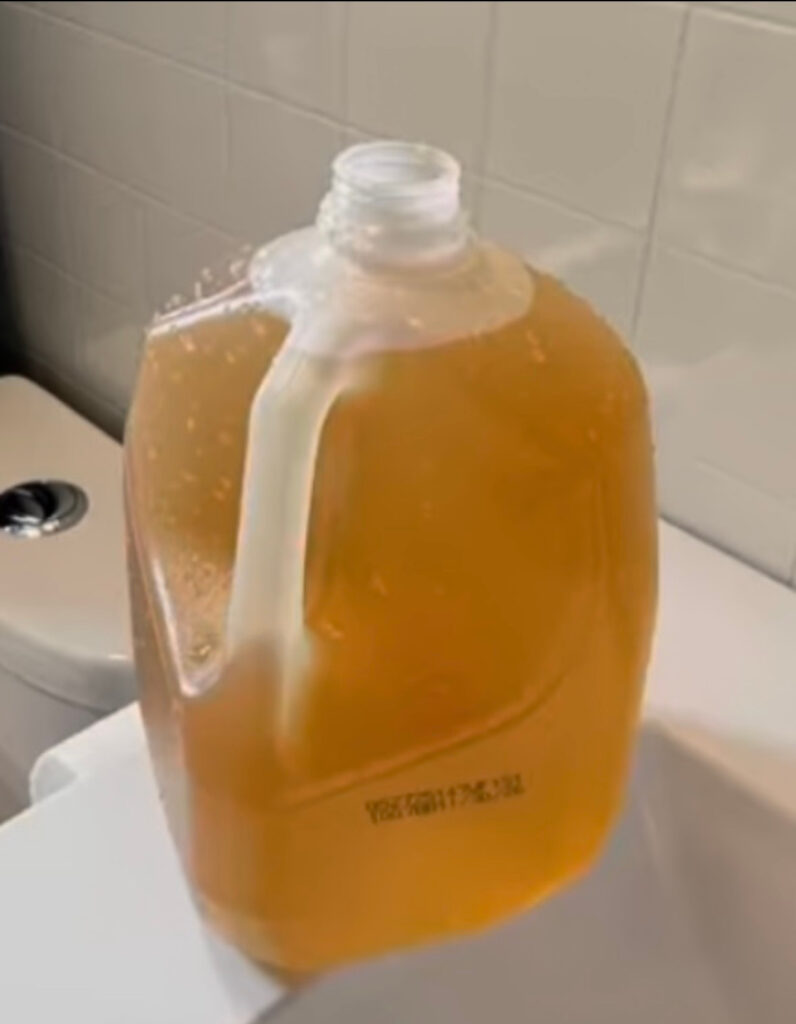
In Lapel, Indiana, people are turning on their taps and seeing bright yellow water flow into their sinks, tubs, and baby bottles. Residents describe it as “fluorescent” and “the color of sweet tea,” and photos circulating online and in local coverage are hard to look at if you imagine bathing your kids in it.
Brianna (“Bri”) Davis, a young mom in Lapel, has been documenting this for years: taking photos of her tap, mapping nearby Superfund and brownfield sites, and contacting town officials, the Indiana Department of Environmental Management (IDEM), and the U.S. EPA. Official messages have been mixed. Town and county leaders have repeatedly said the water is safe to drink, while state and federal representatives have advised against consuming discolored water at all .
Lapel is not alone. Anderson and other Madison County communities have reported brown, foul‑smelling water, documented PFAS contamination, and decades‑old pollution that residents link to serious health problems, including liver disease and cancer. What is unfolding across Madison County is not just a series of plumbing glitches; it is a long, painful story of aging infrastructure, historical contamination, and residents who have had to become their own investigators .
For anyone living with water like this, the issue is not abstract. It is watching baths fill with discolored water, wondering what is on your dishes, and listening to people in authority tell you it is ‘fine’ when everything you see and smell says otherwise. Trust is not something that can be requested on a flyer; it has to be earned back with clear information, straightforward limits, and a willingness to say ‘we don’t know yet’ when that is the truth.
Insanitek is not a regulatory agency and cannot “declare” water safe or unsafe. What a small, apprenticeship‑driven lab can do is help communities like Lapel and Anderson organize their questions, design modest but meaningful tests, and turn scattered photos and documents into clear, usable information.
What Insanitek Can (and Cannot) Do
The first responsibility is honesty about scope. A small lab cannot do everything a fully accredited environmental testing facility or government lab can do, and it should not pretend to. Insanitek is building toward formal lab accreditation; for now, the focus is on small, well‑defined checks and clear communication that support, rather than replace, work by utilities, accredited laboratories, and regulators. Guidance for small environmental labs emphasizes working within well‑defined capabilities, documenting methods and limitations, and communicating results clearly so they can inform, not mislead, as per the Small Commercial Laboratory Group.
Within that frame, Insanitek can support community‑driven efforts in three main ways:
-
Help organize the evidence residents already have
Bri and others in Madison County have collected years of photos, meeting notes, agency letters, and snippets of test results. Insanitek can help structure this: timelines of discolored water events, maps of reported issues, lists of public statements from officials, and summaries of what has and has not been tested. This alone can make community advocacy more coherent and harder to dismiss. -
Design and run small, clearly scoped tests where appropriate
Where it aligns with current equipment and training, Insanitek can assist with basic, small‑scale water checks—carefully chosen parameters and simple, repeatable sampling plans that add information about how conditions change across taps, times, or neighborhoods. These are not compliance tests and would be framed explicitly as informational and preliminary. Anything beyond that still has to go through utilities, accredited labs, and regulators. -
Translate technical information into plain language
Residents in Lapel and Anderson have repeatedly said they feel ignored, gaslit, or buried in jargon while living with water they do not trust. Insanitek can take test results—whether from community sampling, utilities, or agencies—and explain in accessible terms what was measured, what the numbers mean, what they do not tell us, and what questions remain. That kind of translation can be used in town halls, grant applications, or conversations with health providers.
What Insanitek will not do is offer legal advice, guarantee safety, or be used as a shield by officials to say “the lab says it’s fine.” The work is intended to strengthen residents’ understanding and voice, not replace the responsibility of those in charge of the water system. Data or summaries from Insanitek projects may support community conversations and decision‑making, but acceptance or use of those materials by agencies, courts, or other institutions is at their discretion.
Insanitek’s commitment is to be honest, careful, and on the side of the people turning on the tap. That means listening first, being transparent about what the lab can and cannot measure today, and refusing to offer blanket reassurances when the data are incomplete. Any testing or documentation provided by Insanitek is for informational and educational purposes and does not replace testing or determinations by utilities, accredited laboratories, regulators, or medical and legal professionals.
Many residents in Madison County already feel dismissed or misled by official channels. Insanitek will not tell you to ‘just trust’ any lab, agency, or official statement. The goal is to help you understand what has been done, see where the gaps are, and make your own decisions about when to push, when to escalate, and when to bring in additional support.
Why Start with Lapel and Madison County
Madison County has become an uncomfortable case study in how long communities can struggle with water while leadership offers partial, conflicting, or delayed answers. In Lapel, mothers have stood before town council with jugs of yellow water and asked basic questions: Would you bathe your children in this? Who is responsible for the grant money meant to fix it? Why are we still here after years of complaints?
In Anderson, residents have connected high PFAS levels and other contaminants to long‑term health problems and documented that a major water plant sits on a Superfund site that has been under scrutiny for decades. Some families now believe that exposure going back to the 1960s contributed to the illnesses and deaths of loved ones .
Starting in Madison County makes sense for Insanitek because:
- Residents are already organized and collecting data; they do not need to be convinced there is a problem.
- There is extensive public documentation—from town plans and council minutes to EPA documents and investigative reporting—that can be pulled together into coherent narratives and visualizations.
- There is a clear need for independent, educationally grounded help to bridge the gap between raw data and public understanding.
In other words, you are not trying to “start a movement” from scratch; you are offering tools and structure to people already fighting for answers.
How People Can Work with Insanitek
Because trust and clarity matter, the invitation needs to be straightforward. For now, that could look like:
- If you are in Lapel, Anderson, Alexandria, or elsewhere in Madison County and are dealing with discolored water:
- Share your town, how often you see discoloration, and whether you already have photos, videos, or test results.
- Indicate whether you are interested in:
- Help organizing and understanding the information you already have.
- Exploring a small, clearly defined community monitoring project, if it fits within current lab capacity.
From there, Insanitek can outline whether a modest project is feasible and what it would realistically deliver: structured documentation, basic checks within the scope of a small lab, and plain‑language summaries that residents can use in their own advocacy.
The Lapel story did not begin with a lab; it began with a mom looking at neon yellow water and refusing to accept “it’s fine” as an answer. Insanitek’s role is to stand beside people like her with careful methods, honest limits, and clear communication—so communities are better equipped to demand the accountability and repairs they deserve.
Ready to send a sample to us or have us come out for collecting 5+ samples? Learn how on our Project: Clean Water page.