Description
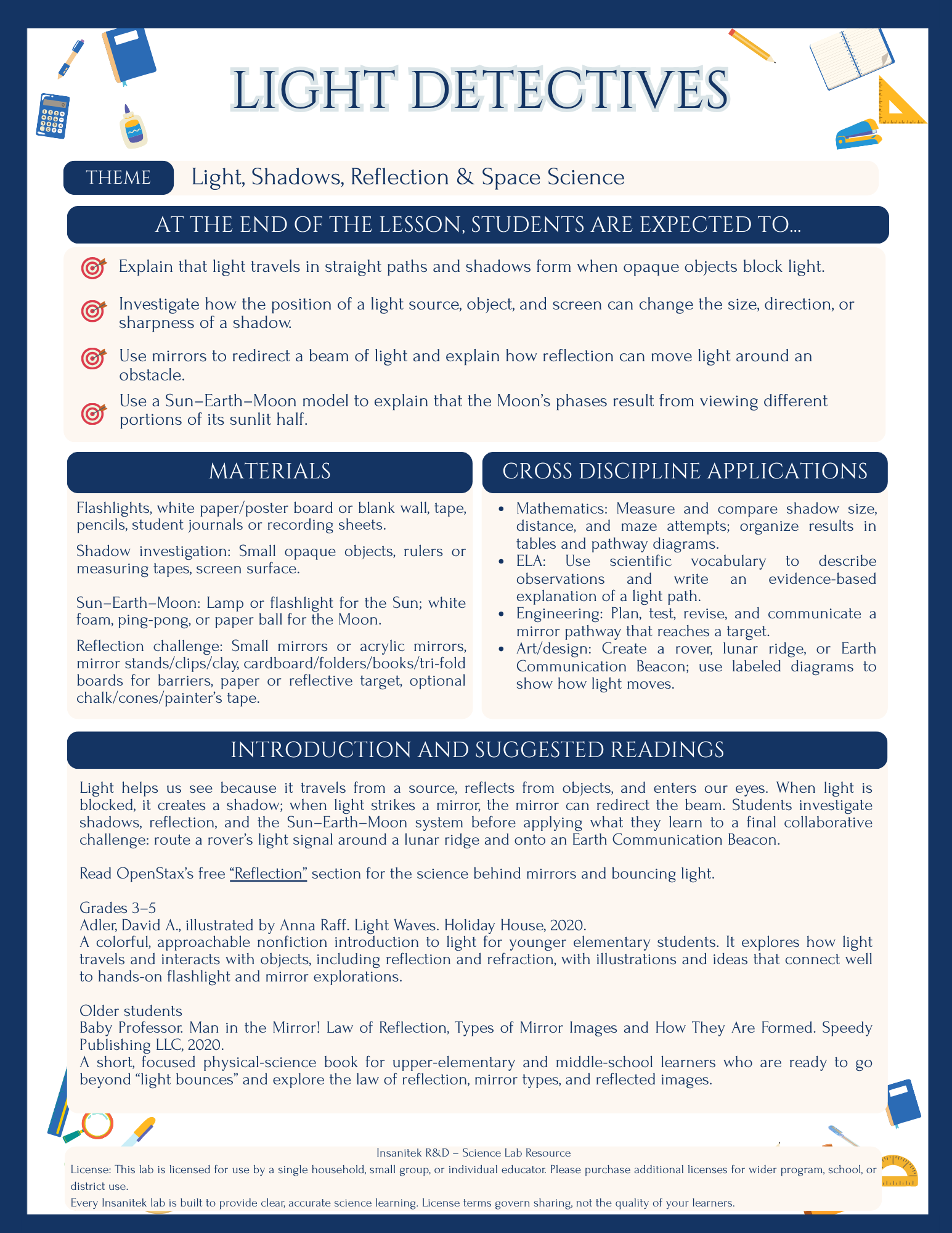
A lunar rover is hidden behind a ridge, and its light signal cannot reach the Earth Communication Beacon directly. Your students have flashlights, mirrors, and a mission: build a pathway that gets the signal around the obstacle.
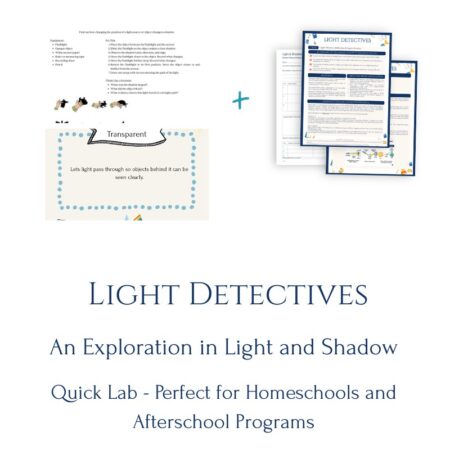
Light Detectives — Tinker Tracks Classroom Edition combines classroom instruction with hands-on physics investigations into light, shadows, reflection, and Moon phases. Students explore how light behaves, record evidence, and apply their findings to a final light-maze engineering challenge. Rather than simply following a demonstration, they predict, test, revise, and explain their designs.
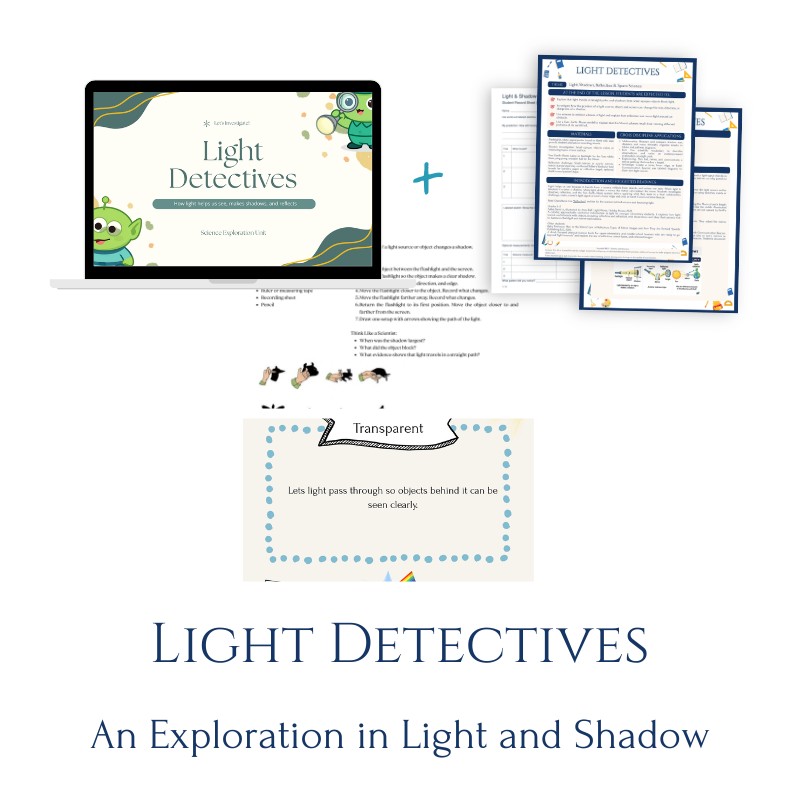
The classroom edition pairs the lecture slides with a lesson plan, vocabulary cards, station cards, and a student worksheet. Use the instructional presentation to introduce the concepts, then move into investigations where students can put those ideas to work.
Explore light through three investigation stations
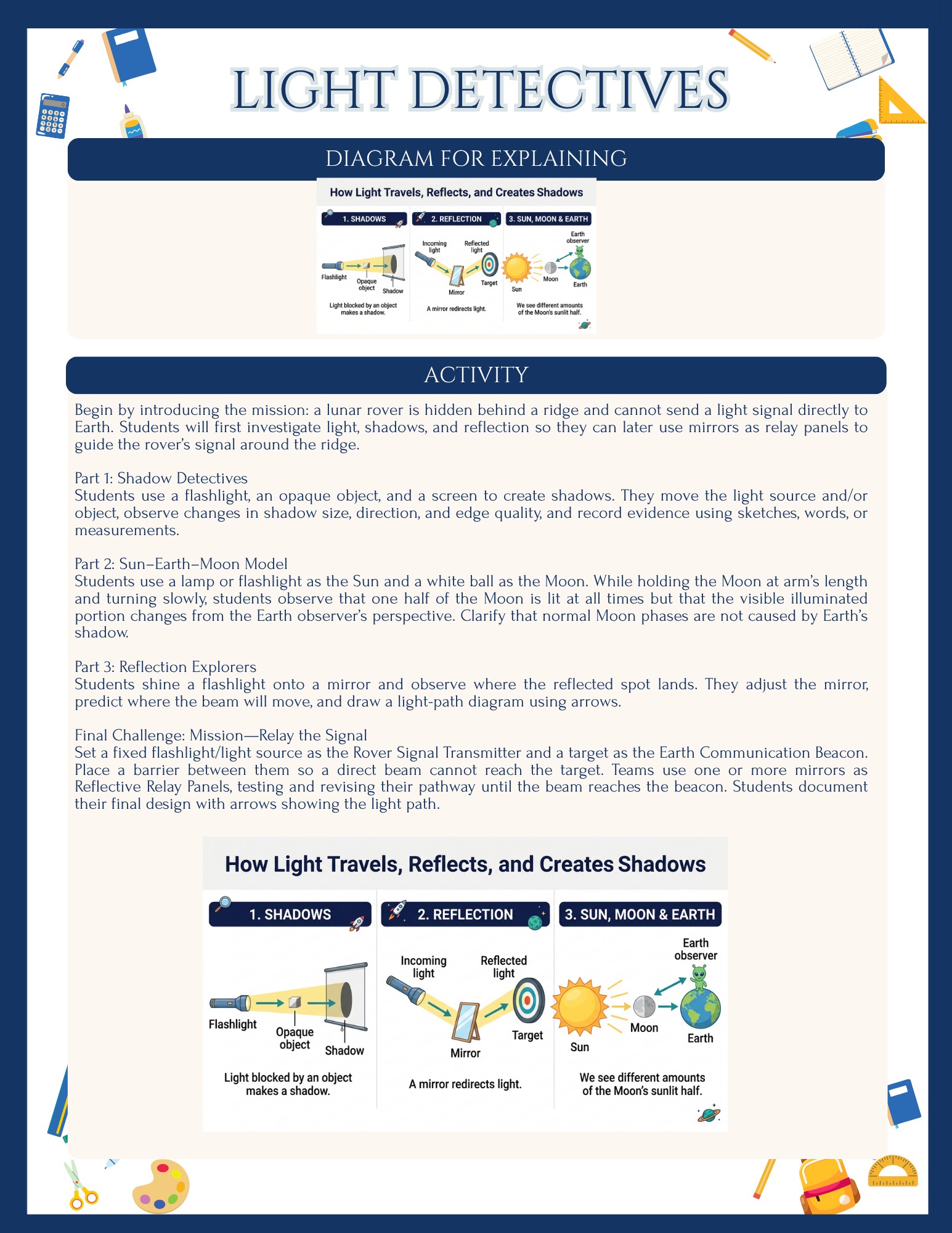
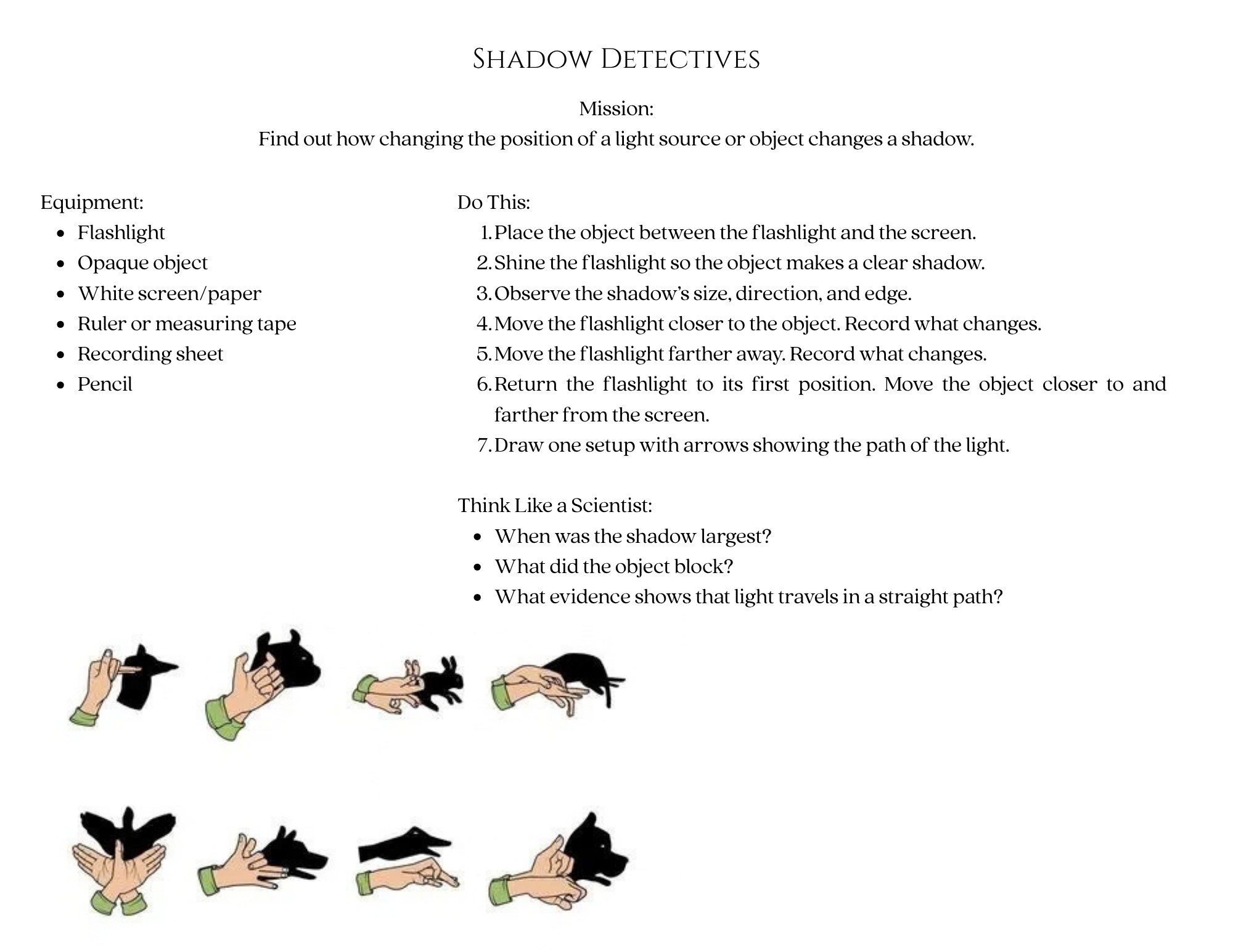
In Shadow Detectives, students use a flashlight, an opaque object, and a screen to investigate how moving the light source or object changes a shadow’s size, direction, and edge sharpness. They document what changed using sketches, written observations, or measurements.
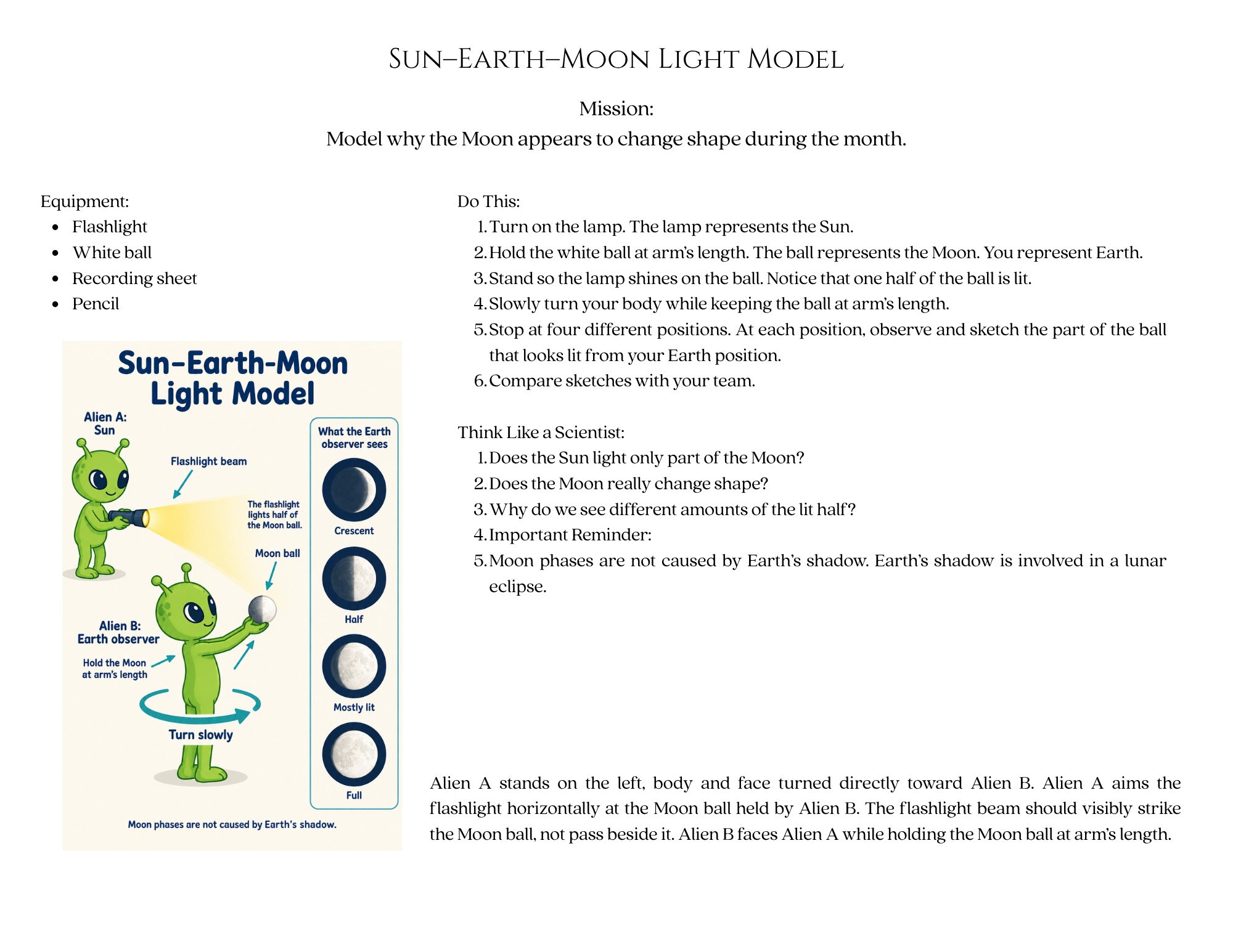
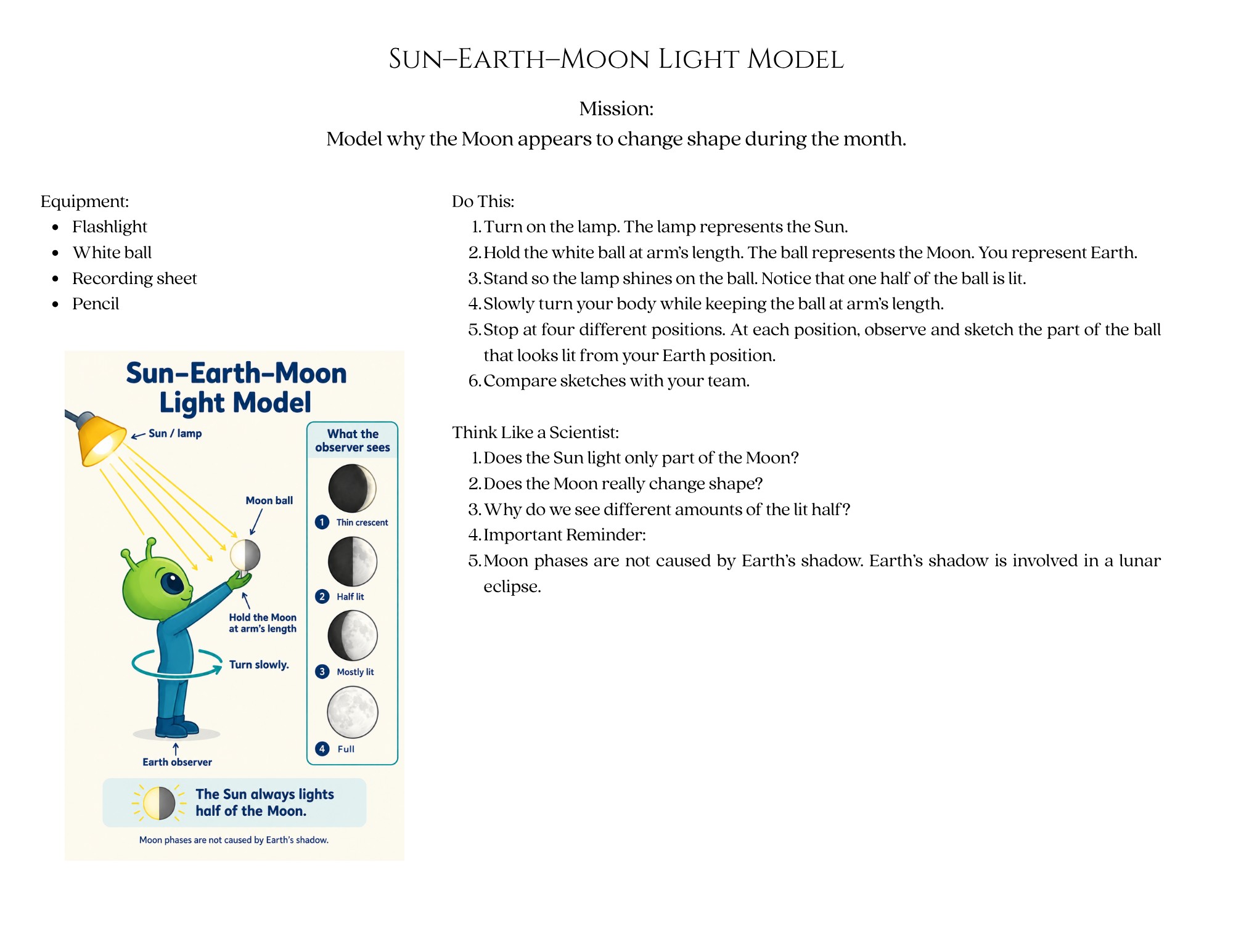
The Sun–Earth–Moon Model gives students a physical way to explore Moon phases. Using a lamp or flashlight and a white ball, they compare how much of the illuminated surface they can see from different positions. Discussion prompts help them distinguish Moon phases from an eclipse rather than attributing the Moon’s changing appearance to Earth’s shadow.
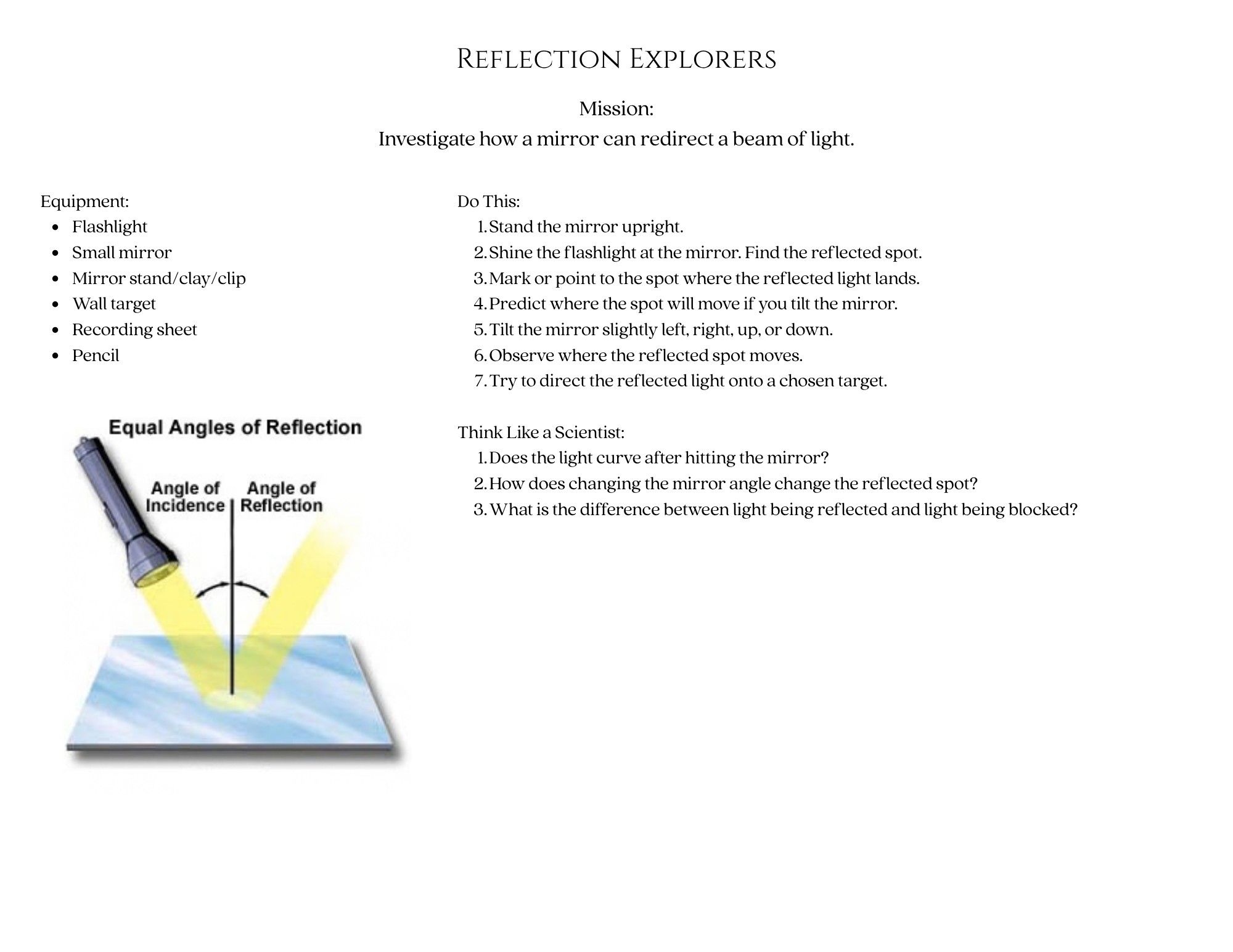
In Reflection Explorers, students shine a flashlight toward a mirror, predict where the reflected spot will land, and adjust the mirror to test their predictions. They draw light-path diagrams with arrows to connect mirror position with the direction of the reflected beam.
Apply the science: Mission—Relay the Signal
The final challenge turns the investigations into an engineering problem. A fixed light source represents the Rover Signal Transmitter, a barrier represents the lunar ridge, and a target becomes the Earth Communication Beacon.
Students position mirrors as Reflective Relay Panels, testing and revising their arrangement until the beam reaches the target. The source, barrier, and target stay in place; students must solve the problem by adjusting the mirrors.
Their final task is to explain the successful route. Where did the light travel in straight lines? Where did it change direction? Which adjustment improved the design? A labeled pathway drawing and recorded observations make the reasoning visible—not just the result.
What’s included
The Tinker Tracks Classroom Edition includes:
- Lecture slides for introducing the science and supporting classroom discussion.
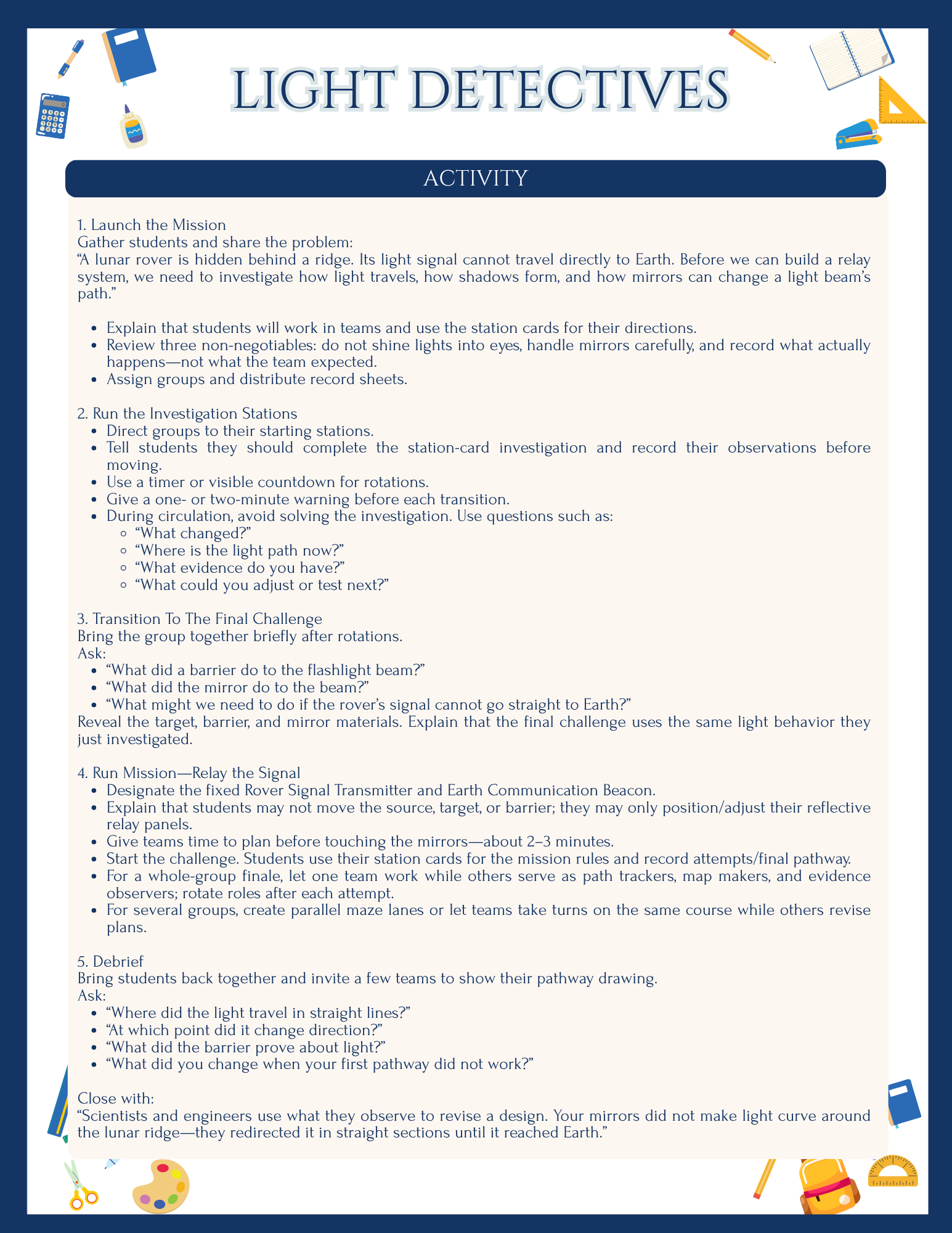
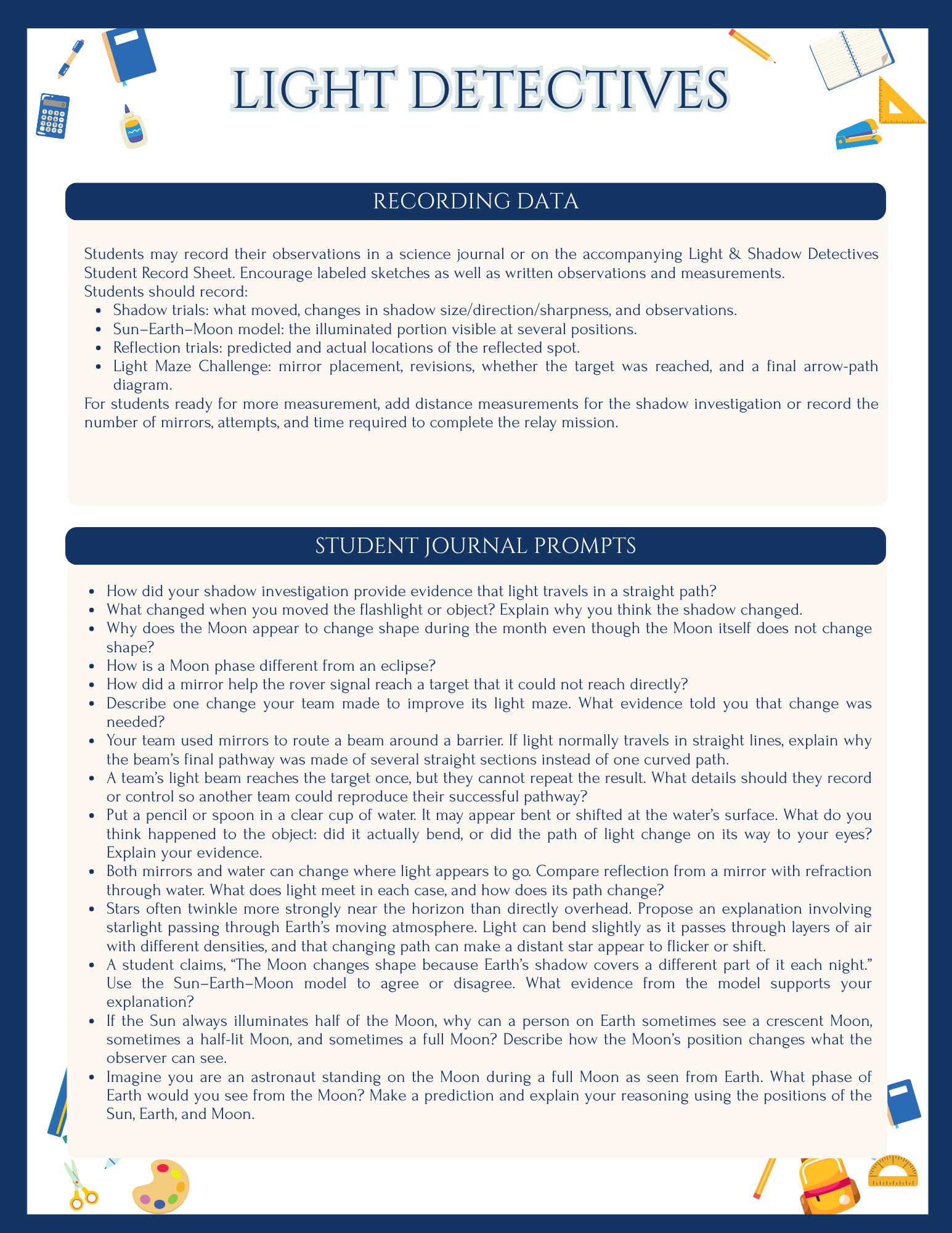
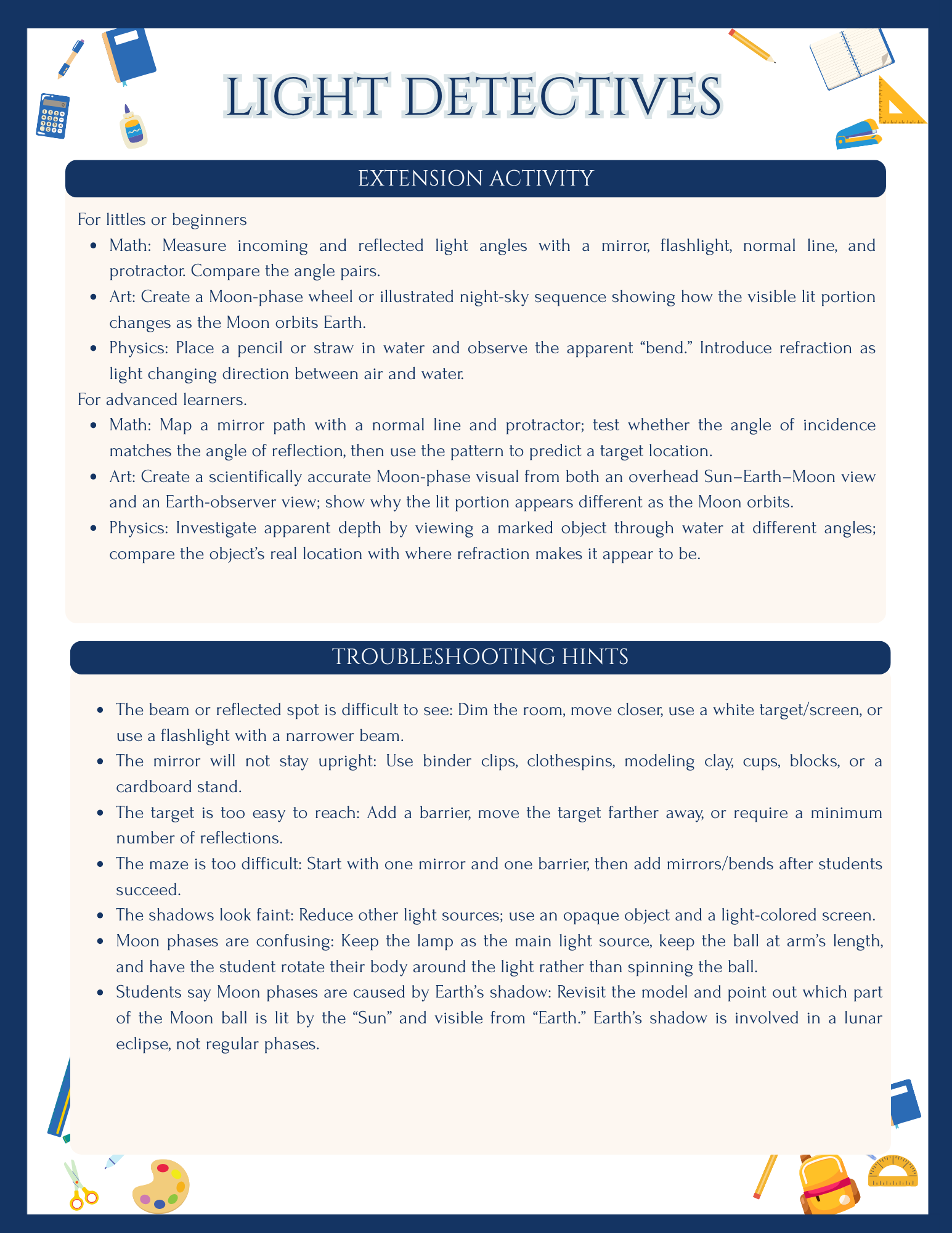
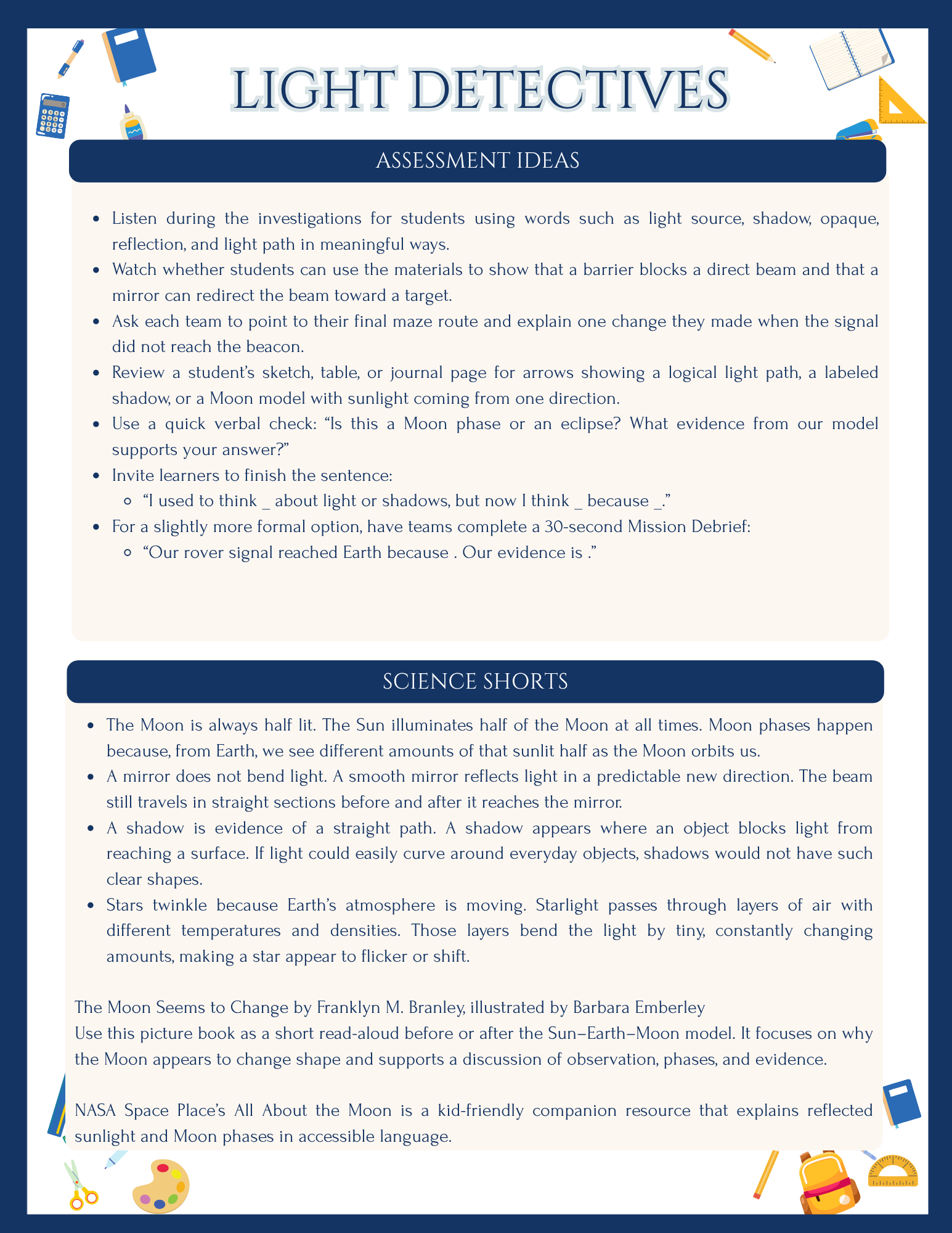
- Lesson plan with the investigation sequence, facilitation prompts, troubleshooting guidance, assessment ideas, and extensions.
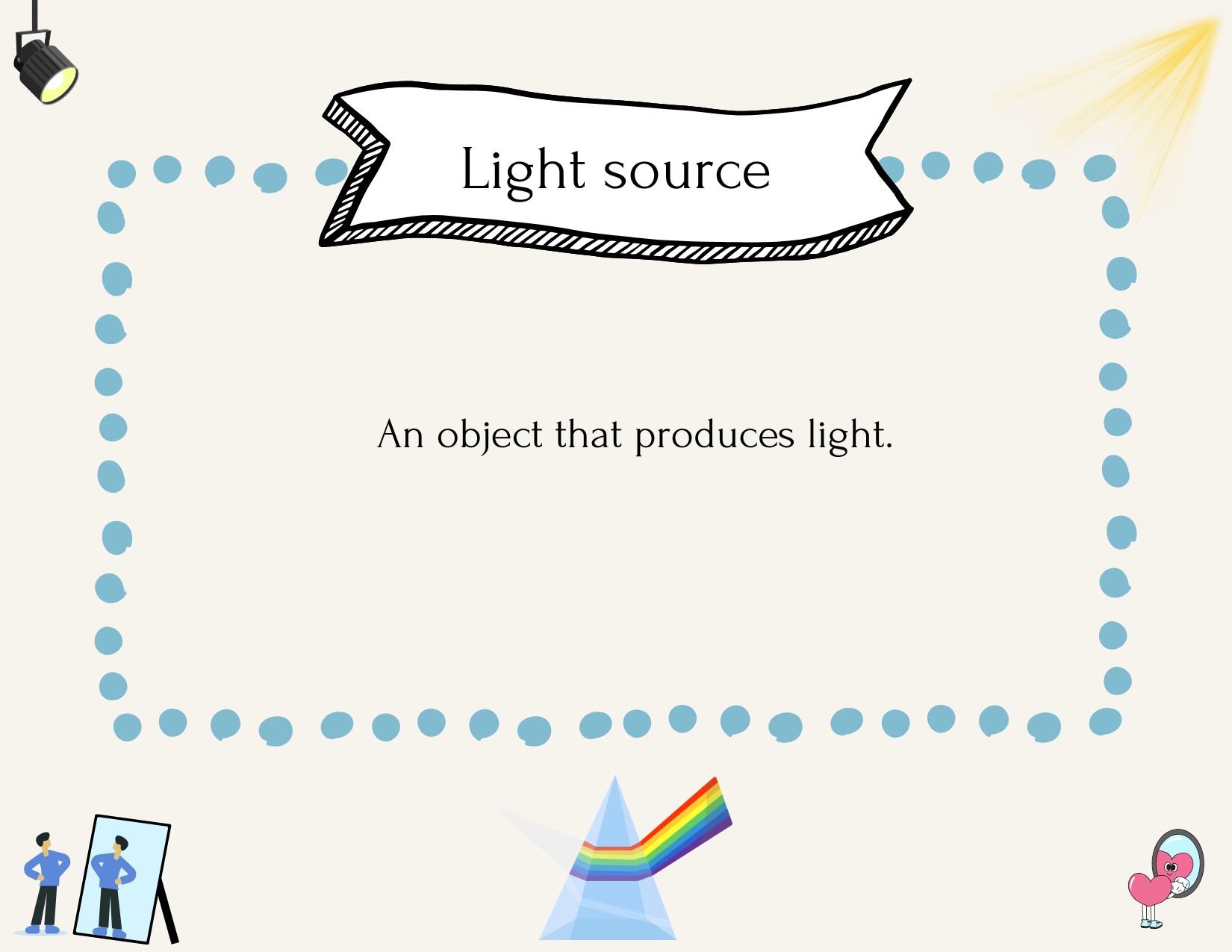
- Vocabulary cards for introducing and revisiting scientific terms.
- Station cards for the investigations and final relay challenge.
- Student worksheet for recording observations, predictions, measurements, and design revisions.
Choose this edition when you want presentation materials alongside the hands-on workshop resources. If you prefer suggested readings instead of a lecture presentation, see the Light Detective Workshop Lab.
Support classroom groups without losing the investigation
The lesson plan provides guidance for station rotations, transitions, and a shared final challenge. Students can work in teams, with opportunities to serve as path trackers, map makers, and evidence observers.
For larger groups, set up parallel maze lanes or let teams take turns while others revise their plans. During investigations, prompts such as “What changed?” and “What evidence do you have?” keep attention on observation and reasoning rather than having the educator solve the pathway for students.
Materials and preparation
Supply flashlights, a light-colored screen or blank wall, small opaque objects, rulers or measuring tapes, a white ball, and small mirrors. Cardboard, folders, books, or similar materials can form barriers, while clips, modeling clay, or simple stands can help hold mirrors in position.
A space where you can reduce competing light will make the reflected spots easier to see. The troubleshooting guidance addresses faint shadows, unstable mirrors, unclear beam paths, and challenges that are too easy or too difficult. Start with a simple route, then add barriers or require additional reflections as students become more confident.
Build evidence-based explanations
The activities give students practice in more than recognizing vocabulary. They measure and compare observations, organize results, draw diagrams, and explain why a design changed.
Assessment options include reviewing light-path drawings, listening for meaningful use of scientific terms, asking students to explain a revision, and using a brief mission debrief. Extension activities offer further work with reflection angles, Moon-phase diagrams, and introductory refraction investigations.
Read the science behind the lab
For an educator reference or a companion reading, explore Light Reflection Explained: Mirrors, Moonlight, and Everyday Surfaces.
The article provides the “why it works” foundation for the mirror investigations: how reflected light reaches our eyes, why surfaces behave differently, and how a mirror redirects a beam. It supports the lab without replacing the classroom presentation or station investigations.
License
Licensed for use by a single household, small group, or individual educator. Please purchase additional licenses for wider program, school, or district use.
Bring light, shadows, and reflection into a classroom investigation where students have a clear mission—and must use their evidence to explain how they accomplished it.

&url=https://insanitek.net/product/ski-jump-physics-marble-ramp-stem-lesson-with-vocabulary-flash-cards/&media=https://insanitek.net/wp-content/uploads/2025/11/Ski-JumpImage.jpg)


Reviews
There are no reviews yet.