A flashlight beam hits a mirror, and the spot on the wall jumps across the room. A dark window becomes reflective after sunset. The Moon looks bright enough to cast shadows, even though it does not make visible light of its own. These are not separate tricks of light—they are different outcomes of the same physical process: reflection.
This article explains what happens when light reaches a surface, why a mirror can redirect a beam predictably while paper cannot show your face, why the Moon is visible, and how reflected light lets you see the ordinary objects around you. It is a broad foundation for future work with mirrors, shadow and vision investigations, Moon models, reflective materials, and light mazes.
What Is Light Reflection?
Reflection occurs when incoming light reaches a surface and some of that light leaves the surface on the same side it came from, traveling in a new direction. In technical optics, this is described as reflected radiant flux: part of the light energy that arrives at a material is returned rather than absorbed or transmitted through it.
The incoming path is called the incident ray. The outgoing path is the reflected ray. Between one interaction and the next, each ray travels in a straight line. Reflection changes the ray’s direction at a surface; it does not make light wander or curve through open air.
That distinction matters because it gives you a reliable way to reason about what you see. A beam from a flashlight can travel to a mirror, reflect from the mirror, and continue toward a wall. Sunlight can travel to the Moon, reflect from its surface, and then continue through space toward Earth. NIST measures reflectance under specified geometric and spectral conditions, meaning that the amount and direction of reflected light depend on the material, illumination angle, viewing geometry, and wavelength (National Institute of Standards and Technology [NIST], 2023).
How We See Objects Through Reflected Light
Most of the objects around you are not light sources. A book, a chair, a leaf, a person, a paved street, and the Moon become visible when light from a source reaches their surfaces and some of that light travels into your eyes.
The basic path is:
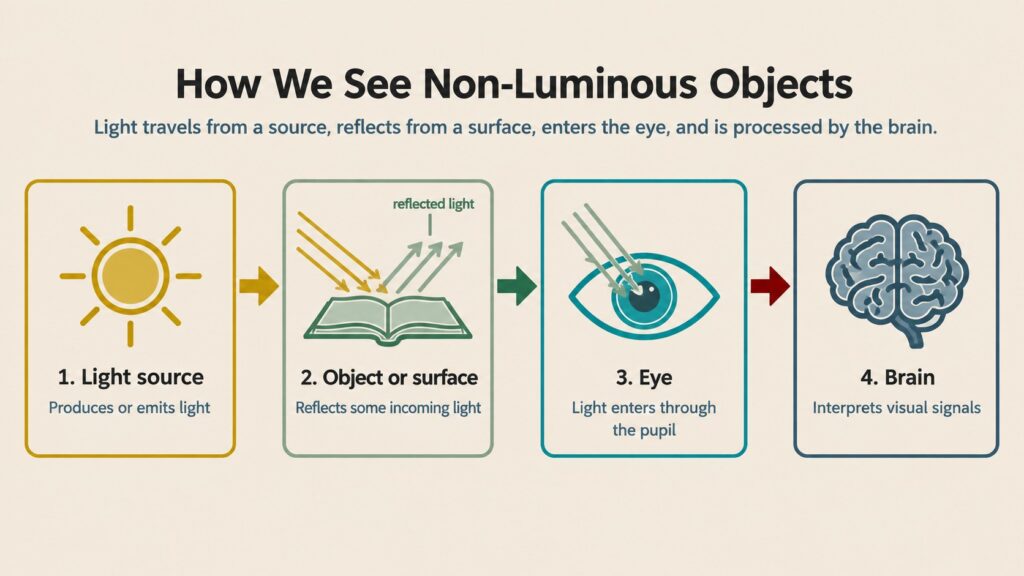
Once light enters the eye, the cornea and lens help focus it on the retina. Photoreceptor cells in the retina convert light energy into electrical signals, which travel through the optic nerve and are processed by the brain. The National Eye Institute describes this chain from incoming light to retinal signaling and visual perception. (National Eye Institute, 2022).
This explains why a room can contain the same objects in daylight and darkness but look completely different. In a dark room, the furniture has not vanished. There is simply too little light reflecting from its surfaces into your eyes for you to see it clearly.
It also explains why an object’s appearance is not determined by the object alone. What you perceive depends on the illumination available, the wavelengths the material absorbs or reflects, the surface’s geometry, and the portion of reflected light that reaches your eyes. Research on color constancy emphasizes that color is a visual sensation built from light reflected by an object under a particular illuminant, not a colored substance that the eye reads directly from the object. (Morimoto, 2024).
A red shirt under white light, for example, absorbs a substantial share of other visible wavelengths and reflects relatively more long-wavelength light toward your eyes. Under a strongly colored lamp, that same shirt can look markedly different because the light arriving at the fabric has changed. A black object is not necessarily receiving no light; it generally reflects a smaller fraction of the incident visible light than a pale object does.
When Light Meets a Surface: Reflection, Absorption, and Transmission
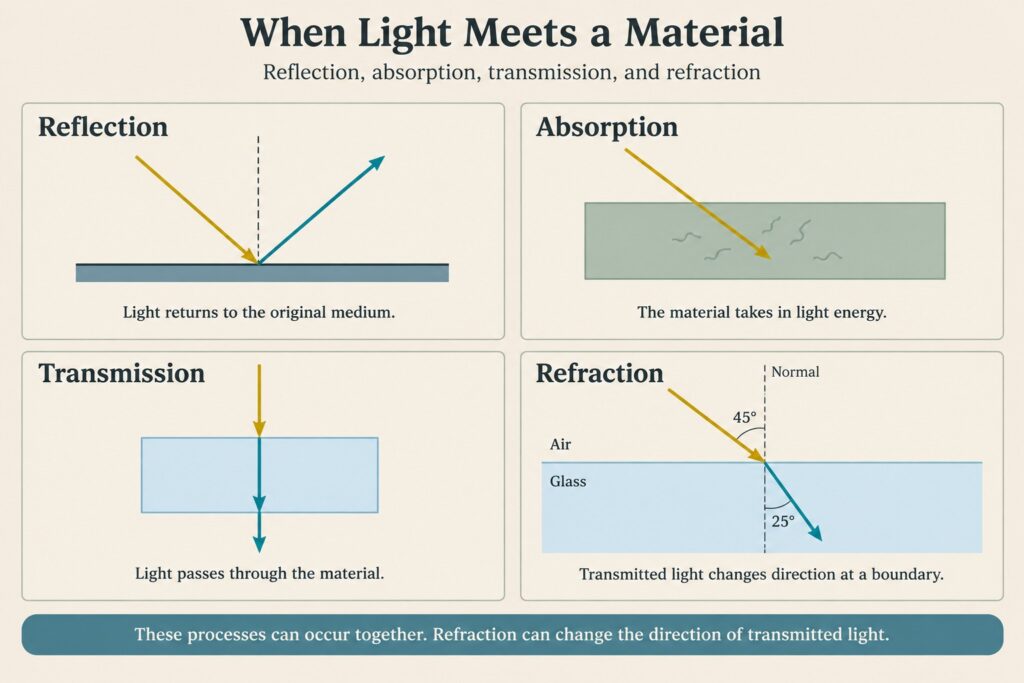
When light reaches a material boundary, several things may happen at the same time:
- Some light can reflect from the surface.
- Some light can be absorbed by the material.
- Some light can transmit through the material.
- Light that enters a new material can also change direction through refraction.
These are not mutually exclusive categories. Clear window glass is a familiar example. It transmits much of the daylight from outdoors, which is why you can see through it. But it also reflects some indoor and outdoor light, which is why a window can show glare, a faint image of your face, or a bright reflection of an indoor lamp.
The balance changes with the material and circumstances. A darker material often absorbs more visible light than a white material, which commonly reflects a larger proportion across the visible spectrum. A glossy black surface may still produce a very bright reflection of a lamp because it can have low diffuse reflectance while maintaining a strong specular component. In other words, “dark” does not mean “unable to reflect.”
Reflectance is the fraction of incident light that a surface returns. It is a physical property. Brightness and lightness are related perceptual experiences, shaped not only by reflectance but also by lighting conditions and the visual system’s interpretation of a scene. (Kim, 2024).
Specular and Diffuse Reflection
A mirror and a sheet of printer paper can both reflect light. The reason one can show your face and the other usually cannot is not whether reflection occurs—it is how the reflected rays are distributed.
Specular Reflection: A Predictable Light Path

Specular reflection is the orderly, directional reflection associated with smooth surfaces. A flat mirror is the clearest example. If a group of rays reaches the mirror in an organized pattern, the reflected rays leave in an organized pattern too. That preserved pattern can reach your eyes as a recognizable image.
Still water, polished metal, glossy tile, a clean phone screen, and a shiny spoon can also produce specular reflections. Their reflected images may be distorted, dim, or incomplete because the surface is curved, imperfect, or only partly smooth, but the principle is the same.
Specular reflection also produces glare. Glare is not “extra light” appearing from nowhere. It is reflected light concentrated into a direction that reaches your eyes, often from a source much brighter than the surrounding scene. This is why an angled laptop screen, a wet road, a window, or a glass tabletop can become visually uncomfortable in the wrong lighting arrangement.
Diffuse Reflection: Why Ordinary Objects Are Visible
Diffuse reflection occurs when a surface sends reflected light in many overall directions. Paper, fabric, unpolished wood, painted walls, leaves, concrete, and the Moon are common examples.
The word diffuse can create a misleading impression that the surface somehow ignores the law of reflection. It does not. At every small patch of a surface, the reflected ray still follows the same geometric rule as it does at a mirror. The difference is that an uneven surface contains countless tiny patches oriented in different directions. Their surface normals point different ways, so the reflected rays leave in many different directions overall.
That is why you can read a page from many positions in a room. The page is reflecting light toward many potential observers, but it is not preserving the organized pattern necessary to form a sharp image of the lamp shining on it.
At a deeper level, “smooth” and “rough” are not absolute labels. A surface’s optical behavior depends on its surface structure relative to the wavelength of the incoming light. That is why a material may feel smooth to a fingertip but still spread visible light broadly, or may appear glossy under one viewing geometry and dull under another. In optical measurement, diffuse and specular reflectance are treated as distinct components of a surface’s reflected light (National Institute of Standards and Technology, 1998).
Why Mirrors Redirect Light
Mirrors are useful because their smooth reflective surfaces let us predict the new direction of reflected light. The central rule is the law of reflection:
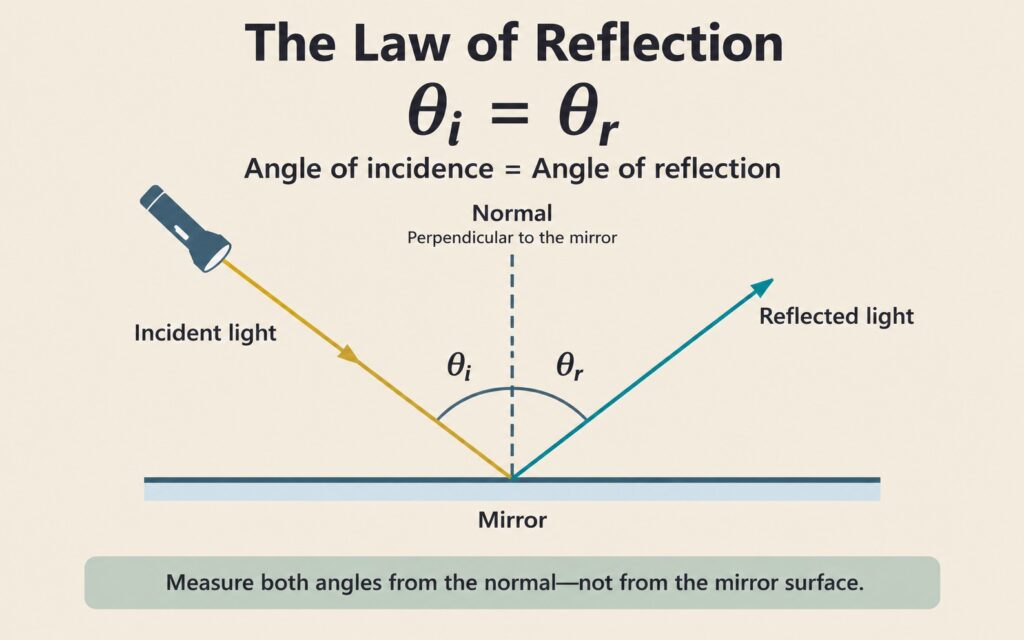
Both angles are measured from the normal: an imaginary line perpendicular to the surface where the ray strikes. They are not measured from the face of the mirror. That detail is the source of many incorrect diagrams and many frustrating light-maze attempts.
Imagine a narrow beam striking a flat mirror:
- The incident ray travels straight toward the mirror.
- At the contact point, draw the normal at a right angle to the mirror.
- Measure the incident angle between the incoming ray and the normal.
- The reflected ray leaves on the opposite side of the normal at the same angle.
- Rotate the mirror, and the normal rotates with it, changing the direction of the reflected ray.
A small rotation of a mirror can therefore move the reflected spot a long way across a distant wall. The mirror has not bent light during its trip through air. It has changed the beam’s direction at the surface, and the beam then continues in a new straight path.
The equal-angle relationship is the familiar geometric form of the law of reflection. At a more fundamental level, reflection and refraction at material boundaries can be modeled using electromagnetic wave behavior and the optical properties of the two materials. Feynman’s treatment of reflection emphasizes that the equal-angle law is a reliable observable result, while the amount of light reflected depends on details of the interface and the light itself. (Feynman, Leighton, & Sands, n.d.).
Why the Moon Is Visible
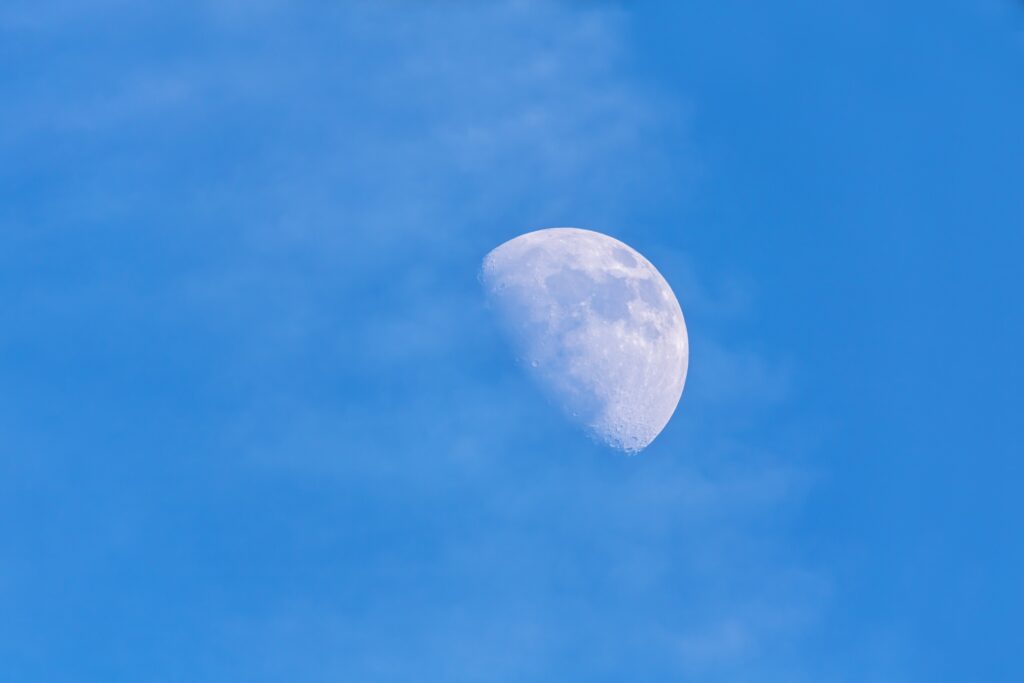
The Moon is a large-scale example of reflected light, not a light source in its own right. It does not produce the visible light we call moonlight. Sunlight strikes the Moon’s surface, and some of that light reflects outward into space. A fraction of the reflected sunlight reaches Earth and enters our eyes.
NASA explains that the Moon is always half illuminated by the Sun, even though the amount of that lit half visible from Earth changes over the lunar cycle. “Moonlight” is reflected sunlight. (National Aeronautics and Space Administration [NASA], 2023).
The Moon is not a polished mirror. Its dusty, cratered, rocky surface produces predominantly diffuse reflection. It sends light outward in many directions rather than forming a crisp image of the Sun. That is why the Moon can be visible from Earth without looking like a mirror in the sky.
The Moon section belongs in a reflection explainer because it reinforces an important principle: an object does not need to be shiny to reflect enough light to be seen. It does not need to reflect most of the light striking it, either. It only needs to reflect enough light in the direction of an observer.
This is not a full explanation of Moon phases or eclipses. The reflection foundation is simply that sunlight reaches the lunar surface, the surface reflects some of it, and observers on Earth see the reflected light. For a dedicated investigation, readers can [learn why the Moon is visible by reflected sunlight][internal link: future Moon observation or Moon-phase model activity].
Everyday Examples of Light Reflection
Reflection is operating around you all day, including in situations where no clear image appears.
A white ceiling diffusely reflects lamp light, helping spread illumination through a room. This is one reason a room with pale walls and ceilings can feel more evenly lit than a room with dark, strongly absorbing finishes.
A stainless-steel spoon may show a sharp reflection on its polished bowl and a blurrier reflection on a brushed handle. The two areas can be made of similar material, but differences in surface texture change how the light leaves them.
A puddle can reflect the sky or a streetlamp strongly from one place and seem almost nonreflective from another. The puddle did not stop reflecting. Instead, its specularly reflected light is traveling in a direction that may not reach your eyes from your current position.
A window can be transparent-looking in daylight yet reflective-looking at night. During the day, transmitted outdoor light may dominate your view. At night, a brighter indoor room can make reflections from the glass more noticeable than the comparatively dim scene outside.
A leaf may look green because of the wavelengths it reflects under the available illumination, but the appearance can shift under a different light source. A material’s physical reflectance is important, but the light source and your visual system are part of the final result. (Morimoto, 2024; Kim, 2024).
Light Mazes: Reflection in Action
A light maze is a direct application of reflected-light geometry. The goal is simple: guide light from a source to a target using one or more mirrors. The reasoning is more interesting than it first appears.
A flashlight beam travels in straight lines between surfaces. Each mirror becomes a place where you can redirect that path. If the direct route to a target is blocked, you can angle a mirror so the incident ray reflects toward a second mirror or directly to the target.
The most effective planning method is often to work backward:
- Identify the target.
- Decide the direction from which light must arrive at it.
- Position the final mirror so it can send light along that path.
- Trace backward from that mirror to the previous mirror or the source.
- Test the beam path and adjust each mirror using the normal and equal-angle rule.
The key concept is not that a mirror “bends” a beam. The beam travels straight before and after each mirror. The mirror redirects it at a surface according to the law of reflection.
This turns a simple-looking challenge into real scientific reasoning. Learners can make a prediction, set a mirror angle, observe the resulting path, identify the mismatch between prediction and result, and revise the setup. The activity also exposes practical factors that matter in real optical systems: beam width, mirror size, surface cleanliness, stability of the supports, viewing position, and ambient light.
To investigate these ideas physically, [explore reflected light with the Light Detective’s Lab][internal link: Light Detective’s Lab page]. The lab serves as a concrete investigation of the reflection science explained here; this article remains the broader reference point for future mirrors, Moonlight, vision, and surface-behavior activities.
Reflection and Refraction Are Not the Same
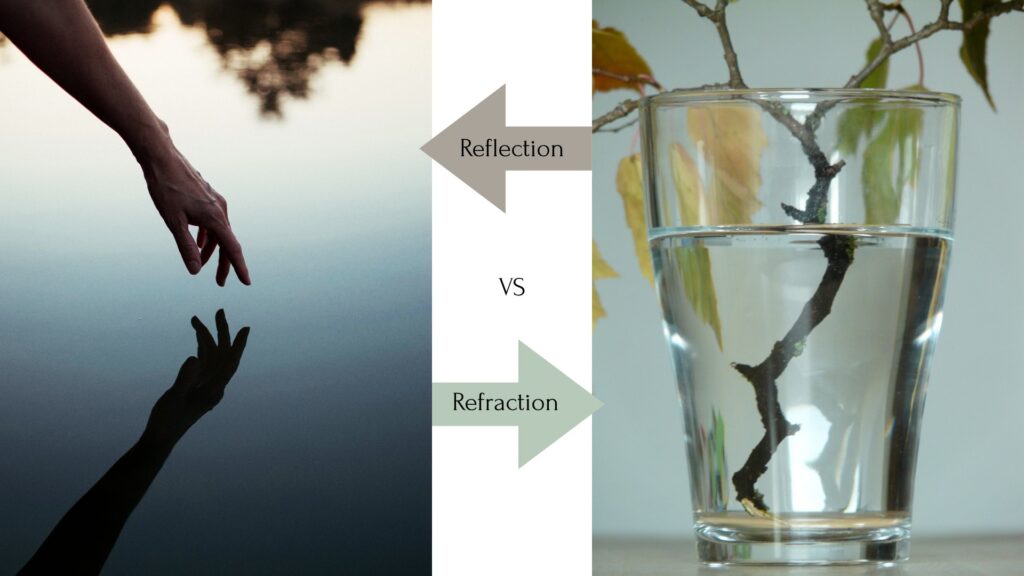
Reflection and refraction both happen when light reaches a boundary between materials, but they describe different light paths.
Reflection occurs when light changes direction at a surface and remains in the original material. A beam striking a mirror and returning through air is reflecting.
Refraction occurs when light enters a different material and changes direction because its speed changes in the new medium. Light moving from air into water or glass can refract. That is why a straw in a glass of water can appear bent and why lenses can focus light.
A window can demonstrate both behaviors at once. Some light reflects from the glass surface and may create glare or a faint image. Some light enters the glass, refracts at the boundary, and may transmit through to the other side.
The distinction is worth keeping clear:
- Reflection changes a light path at a surface.
- Refraction changes a light path as light enters a new material.
For a deeper comparison, see [reflection changes a light path at a surface; refraction changes it as light enters a new material][internal link: future reflection versus refraction article].
Explore Light Reflection Hands-On
Reflection is not limited to mirrors or astronomy. It explains why you can read a page, see a person across a room, watch moonlight on a sidewalk, notice glare on water, and guide a flashlight around an obstacle.
When you notice a reflection, trace the light path. Where did the light start? Which surface did it meet? Was that surface smooth enough to direct light predictably, or uneven enough to distribute reflected light in many directions? Which rays reached your eyes?
Then move from explanation to investigation. [Explore reflected light with the Light Detective’s Lab][internal link: Light Detective’s Lab page] and use mirrors, surfaces, and light paths to test the ideas directly.
References
Feynman, R. P., Leighton, R. B., & Sands, M. (n.d.). Reflection from surfaces. In The Feynman Lectures on Physics, Volume II, Chapter 33. California Institute of Technology.
Kim, J. (2024). A tutorial on the physics of light and image shading. Journal of Vision.
Morimoto, T. (2024). Mechanisms of human color constancy underpinning stable color perception. Frontiers in Psychology.
National Aeronautics and Space Administration. (2023, June 5). Moon phases. NASA Science.
National Eye Institute. (2022, April 20). How the eyes work. National Institutes of Health.
National Institute of Standards and Technology. (1998). Spectral reflectance.
National Institute of Standards and Technology. (2022, January 4). Measuring up: Light reflection and transmission.
National Institute of Standards and Technology. (n.d.). Spectral reflectance and transmittance.