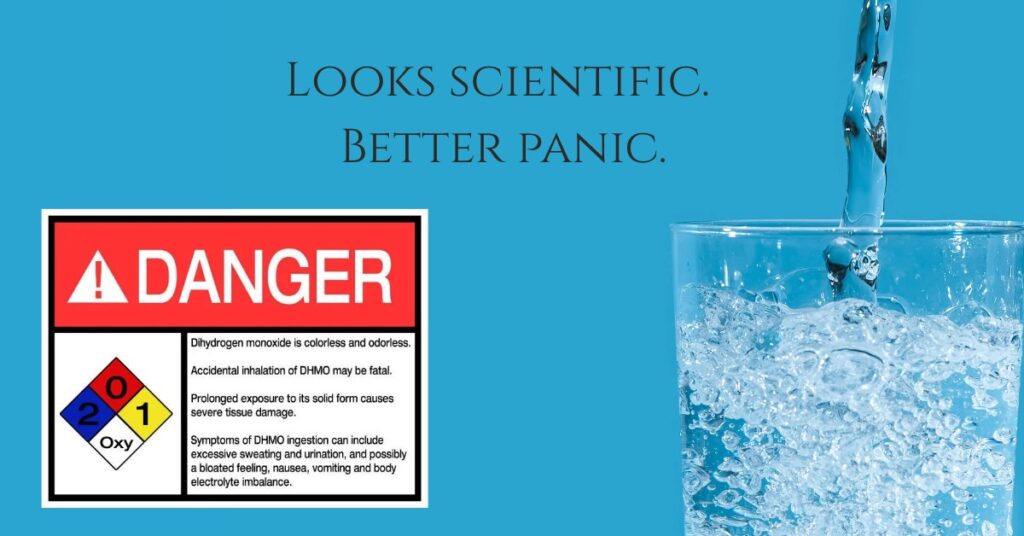
You open your feed between errands and find a warning: something in your water, food, or neighborhood may be harming your family. There is a screenshot, a scientific-sounding explanation, and an urgent instruction to share it.
Being frightened by a claim does not make it true. Wanting it to be false does not make it false, either. Before we decide what to believe, share, or do, we need to examine what supports it.
Learning how to evaluate scientific claims means asking more than whether a post deserves a “true” or “false” label. At Insanitek, we don’t want to stop at calling a claim true or false. We want to explore the science underneath it: what’s happening, how we know, and what questions remain unanswered. Our approach follows four connected principles: research before reacting, follow the evidence, keep asking questions, and understand it well enough to explain it.
Research Before Reacting
A concern can be a good reason to investigate. It should not become the evidence.
That distinction leaves room to take a possible problem seriously without accepting the first explanation attached to it. “Could this affect our health?” is a reasonable question. “This is deliberately being done to harm us” is a claim that needs its own support. Asking the first does not establish the second.
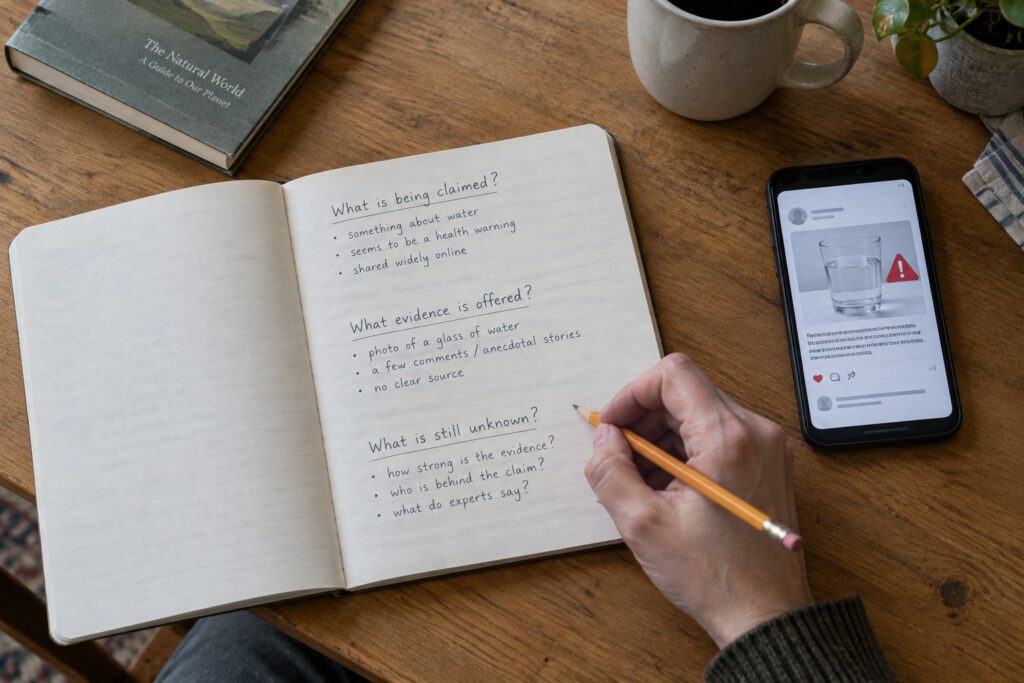
The pause before reacting is a chance to identify what you are actually being asked to believe. What supposedly happened? Who or what is affected? What evidence is offered? Where did the information originate?
Those questions matter because a photograph, a measurement, and an accusation are not interchangeable. A photograph may document something worth investigating without establishing its cause. A measurement may be accurate while the explanation attached to it goes beyond what was measured. Scientific reasoning connects observations to explanations through testing; it does not treat an observation as automatic confirmation of whichever story accompanies it (University of California Museum of Paleontology, n.d.).
Research also means more than finding another post repeating the same story. We want to know what supports the explanation, not merely how often it appears.
Take the concern seriously enough to investigate it—not so literally that you accept the first answer attached to it.
This is a principle for evaluating claims, not an instruction to postpone protective action during an immediate emergency. Pausing before sharing a frightening post and responding promptly to an immediate hazard are different situations.
Follow the Evidence
The goal is not to find a source that makes you feel right. It is to find out what the available evidence actually supports.
That means resisting two tempting destinations: confirmation and reassurance. Research should not be a hunt for proof that your first suspicion was correct. Neither should it be a hunt for someone who promises there is nothing to worry about.
Instead, give attention to the connection between the claim and its support. What did the original document say? What did researchers measure? How did they obtain those measurements? Does the conclusion apply to the circumstances described in the post?
Keep three things separate: what was observed, what someone inferred from that observation, and what the social-media post claimed. These may align. They may also be very different.
A study is not a free-floating verdict. Its methods, scope, and relationship to other findings matter. The National Academies describes scientific knowledge as a collective, cumulative process: confidence grows through evidence considered across studies, rather than through one isolated result. When findings disagree, understanding why is part of evaluating them.
Following the evidence therefore includes being willing to revise a conclusion. Stronger evidence may support an explanation you initially doubted. It may undermine one you found convincing. Neither outcome is a failure of the approach.
The commitment is to the evidence, not to keeping your first answer intact.
Keep Asking Questions
A fact-check can resolve a claim without giving you a full understanding of the subject.
That is not a criticism of fact-checking. Establishing whether a specific assertion is supported is valuable. But a verdict and an explanation do different jobs. One addresses the claim in front of you; the other helps you understand the science underneath it.
Our explainer on lithium in drinking water examines one example of separating an alarming story from the questions it raises. Whether lithium occurs in water is a different question from whether someone deliberately added it. Both are different from whether a particular exposure produces a claimed effect. Each requires evidence relevant to that question.
Finding one true detail does not validate an entire story. Rejecting an unsupported story does not eliminate every worthwhile question underneath it, either.

There may still be something worth understanding: what a technical term means, how a measurement was made, which comparison makes a number meaningful, or what other explanation could account for an observation.
This is where understanding scientific evidence becomes more useful than collecting verdicts. You begin to see not just what the answer is, but why the question needs to be framed a particular way.
Keep the status of the answer clear, too. “Unsupported” means the claim has not been adequately established. “Contradicted by evidence” means relevant evidence counts against it. “Not yet known” identifies an unresolved question. Those are different judgments, not interchangeable ways of saying “false.”
Continuing to investigate does not guarantee certainty. Scientific findings have limitations, and uncertainty needs to be identified and communicated—not concealed or treated as proof that every explanation is equally plausible (National Academies of Sciences, Engineering, and Medicine, 2019).
Keep asking questions to clarify what is known, not to promise yourself that enough searching will remove every unknown.
Understand It Well Enough to Explain It
Repeating a conclusion is not the same as understanding its basis.
“The study found it” leaves a lot unexplained. What did the study investigate? How did the researchers investigate it? What did their results support—and what would go beyond those results?
A useful explanation connects the claim, the evidence, and the reasoning between them. It preserves the limitations that make the conclusion accurate. It also leaves room to say what remains uncertain and what evidence would change the answer.
That is the standard we value: understanding, rather than a performance of certainty.
You do not need to memorize every technical term or become a specialist before discussing something you have learned. But you should be able to explain the central reasoning without replacing it with “an expert said so” or stripping away its qualifications.
Can you explain it in your own words without losing the details that make it accurate?
Sometimes an honest explanation includes a boundary: “This supports that conclusion under these conditions. It does not answer this other question.” Sometimes it includes a gap: “I understand the finding, but I still need help interpreting the method.”
Those statements make the limits of your understanding visible. That is more useful than covering them with confidence.

Why This Matters at Insanitek
At Insanitek, we do not want people to exchange one borrowed conclusion for another. We value the work of understanding how a conclusion was reached.
That is why our explanations should be invitations to think further, not demands to accept our authority. We want readers to examine the reasoning, recognize its limits, and ask questions that move the discussion forward.
The same attitude belongs in hands-on science. What can we observe? What could we measure? How could we test an explanation? What would a result actually tell us?
An activity becomes more than something interesting to watch when those questions guide it. Comparing what an explanation predicts with what we actually observe is central to scientific testing. The point is not simply to produce a result; it is to understand how that result bears on the explanation.
For us, scientific thinking in everyday life means bringing that care to questions outside a laboratory, too. It means making room for curiosity, putting effort into understanding, and being honest about uncertainty.
It also means refusing to use uncertainty as an excuse to say anything we like.
Geek Responsibly
You do not have to become an expert in everything that crosses your feed. But you can ask more of a claim than a frightening headline—and more of yourself than an immediate reaction.
The next time you encounter science misinformation on social media, or a claim whose accuracy you cannot yet judge, give it proportionate attention before believing, sharing, or acting on it. Ask what supports it. Follow the question far enough to understand what the answer does—and does not—mean.
Research before reacting. Follow the evidence. Keep asking questions. Understand it well enough to explain it.
Geek Responsibly.
Bibliography
National Academies of Sciences, Engineering, and Medicine. (2019). Reproducibility and replicability in science. The National Academies Press. doi: 10.17226/25303.
University of California Museum of Paleontology. (n.d.). The core of science: Relating evidence and ideas. Understanding Science, University of California, Berkeley.