You fill water bottles, cook pasta, make coffee, and trust that the tap is doing its ordinary job. Then a post suggests that something is being added to the water supply to affect how people think. Even after the post is gone, it can leave behind a hard question: Do I need to worry?
And people who take the sensible step of researching the claim may find material that makes the question feel even more complicated. There are real news articles discussing whether lithium should ever be added to public water, as well as peer-reviewed papers examining possible associations between naturally occurring lithium in drinking water and population suicide rates. One 2022 paper discusses lithium supplementation as a proposed public-health policy, while emphasizing limited evidence, ethical concerns, community-controlled trials, and monitoring for possible harms—not evidence that such a program is secretly operating (Huth et al., 2022).
That distinction matters. Lithium is a real element, and it can occur in groundwater. Researchers have studied how it moves through natural water systems—including groundwater used for drinking-water supply—by examining geology, water chemistry, environmental sources, and possible health questions (Khalid et al., 2023; Lindsey et al., 2021). But those facts are not evidence that a secret program is adding a “psychiatric suppressant” to municipal water. This article walks through what the available data actually show, how public-water monitoring works, and how to distinguish a meaningful water-quality question from an alarming claim that cannot be tested.
Lithium Is Real, but Context Matters
The U.S. Geological Survey (USGS) compiled lithium data from untreated groundwater collected at 1,464 public-supply wells, 1,676 domestic-supply wells, and 1,560 monitoring wells across 33 principal aquifers in the United States (Lindsey et al., 2021). In the public- and domestic-supply wells studied, lithium concentrations ranged from less than 1 to 396 micrograms per liter (µg/L), illustrating how much naturally occurring concentrations can vary with local geology and groundwater chemistry.
The word untreated is important. These measurements were collected before public-utility treatment, reinforcing that lithium occurrence can be a geological and environmental question rather than a treatment decision. Even the high end of this reported groundwater range is not comparable to a medicinal lithium dose: prescription lithium is managed as a measured drug dose in milligrams, typically taken repeatedly under clinical supervision, while water results are concentrations in micrograms per liter. A water concentration alone cannot be treated as a medication dose because actual exposure depends on how much water a person drinks and other sources of lithium exposure (Lindsey et al., 2021).
A detectable substance is not automatically:
- Deliberately added.
- Harmful at the amount measured.
- Responsible for a person’s symptoms.
- Evidence of a coordinated public-health or behavioral-control program.
A useful mental model is:
Natural occurrence → laboratory detection → deliberate addition
Each statement makes a different claim. “Naturally present” means a substance may have entered water through the environment. “Detected” means a laboratory method measured it above that method’s reporting threshold. “Deliberately added” requires records showing that a named utility intentionally used a defined substance for a stated treatment purpose.
For practical help deciding whether a concern calls for public records, utility questions, or a laboratory test, see Insanitek’s water testing services.
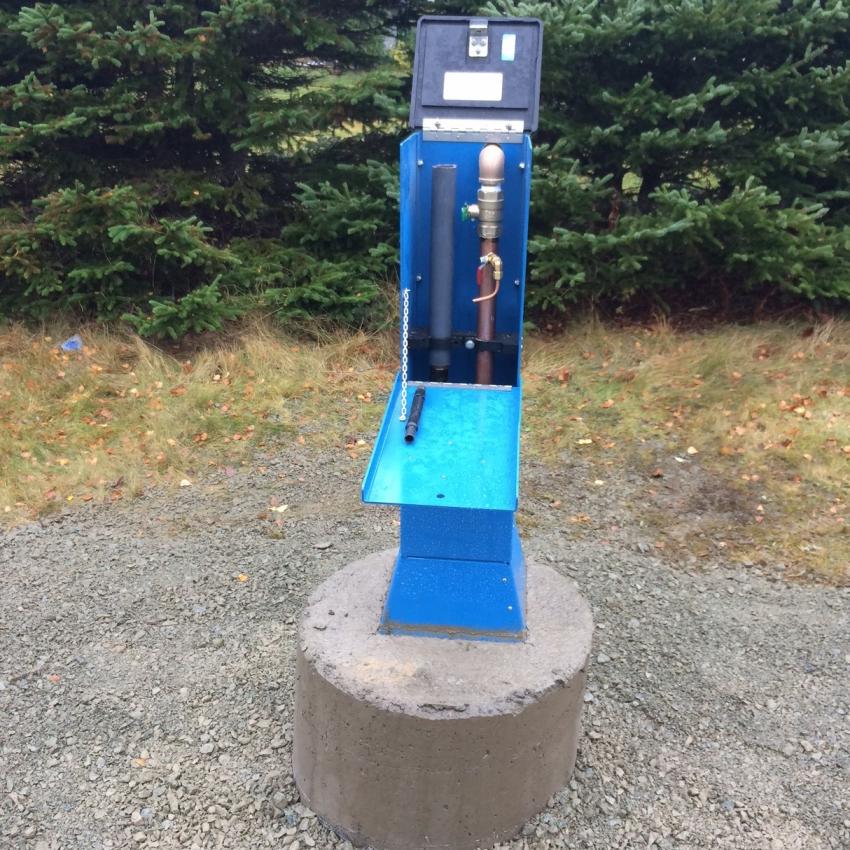
Water-quality sampling station. An example of a dedicated sampling point used by utility personnel to collect distribution-line water samples. Image: Mueller Water Products, Hydro-Guard® Sampling Stations.
What EPA Is Actually Doing About Lithium
EPA’s Fifth Unregulated Contaminant Monitoring Rule, commonly called UCMR 5, is a nationwide occurrence-monitoring program. It required certain public water systems to test for 29 PFAS compounds and lithium between 2023 and 2025. EPA released the final UCMR 5 dataset in August 2026, and the results can be searched through its public Data Finder (U.S. Environmental Protection Agency [EPA], 2026a).
The term unregulated often creates understandable confusion. It does not mean a chemical is invisible, ignored, or freely added to water. It means EPA has not established an enforceable federal drinking-water standard for that substance under the Safe Drinking Water Act.
Monitoring and regulation are related, but they are not the same job:
- Monitoring asks where a substance occurs and at what concentrations.
- A regulatory standard establishes a legally enforceable requirement for public water systems.
- A health reference level gives scientific context for evaluating a result, but is not itself a legally enforceable limit.
For lithium, the UCMR 5 minimum reporting level was 9 micrograms per liter, written as 9 µg/L, or 9 parts per billion. This value is an analytical reporting threshold: it tells laboratories when they must report a result for the program. It is not a health-based drinking-water limit. (EPA, 2026b).
This is a key point for interpreting viral water claims. A result at or above 9 µg/L means that monitoring recorded lithium at or above the UCMR reporting threshold. It does not establish that lithium was intentionally added, that the amount is medically harmful, or that a particular household needs to buy a treatment device.
EPA has used non-regulatory health screening information for lithium, but it does not currently have an enforceable federal maximum contaminant level or drinking-water health advisory for lithium. Research into possible health effects at typical drinking-water exposure levels remains an active area of study.
Why a Secret-Suppressor Claim Does Not Hold Up
Concern about water quality is reasonable. A claim that municipalities are secretly adding a substance to alter behavior is a much larger claim, and it needs evidence that is equally specific.
Technical-sounding language is not enough. The phrase “lithium-sodium hybrid psychiatric suppressant,” for example, is not a usable chemical identity. Lithium and sodium are elements, but simply placing their names next to one another does not identify a compound, a product, a treatment formulation, or an exposure route.
A credible claim would identify the actual substance, its concentration in finished water, the purpose for which it was used, the locations involved, and the records that show it was purchased or applied. It would also include reproducible laboratory evidence.
Chemistry words alone are not evidence. Ask: What was measured? How much was measured? Where was it measured? How was it measured? Who can independently verify it?

What About Brain Fog and Trouble Concentrating?
Brain fog, trouble concentrating, exhaustion, and feeling unlike oneself can be frightening and disruptive. Those experiences deserve to be taken seriously. But “brain fog” is a broad symptom description, not a diagnosis and not a chemical test result.
Sleep disruption, stress, medication effects, mood conditions, infections, nutritional concerns, endocrine conditions, and many other factors can affect attention and energy. It is not scientifically responsible to assign a cause based only on a social-media claim or the fact that a trace substance exists somewhere in drinking-water research.
Water testing can answer a defined environmental question: Is a specific substance present in this sample, and at what concentration? It cannot diagnose cognitive symptoms or establish the cause of a health change. When symptoms are sudden, persistent, severe, worsening, or interfering with daily life, qualified clinical guidance is more appropriate than internet-based chemical speculation.
How to Check What Is in Your Tap Water
Identify Your Water Source
First, establish whether the home is served by a community water system or uses a private well.
A community water system is responsible for required sampling, treatment, compliance, and public reporting. A private-well owner is generally responsible for selecting tests, arranging sampling, and responding to the results. That does not mean private wells are inherently unsafe; it means the record-keeping and testing pathway is different.
Find Your Consumer Confidence Report
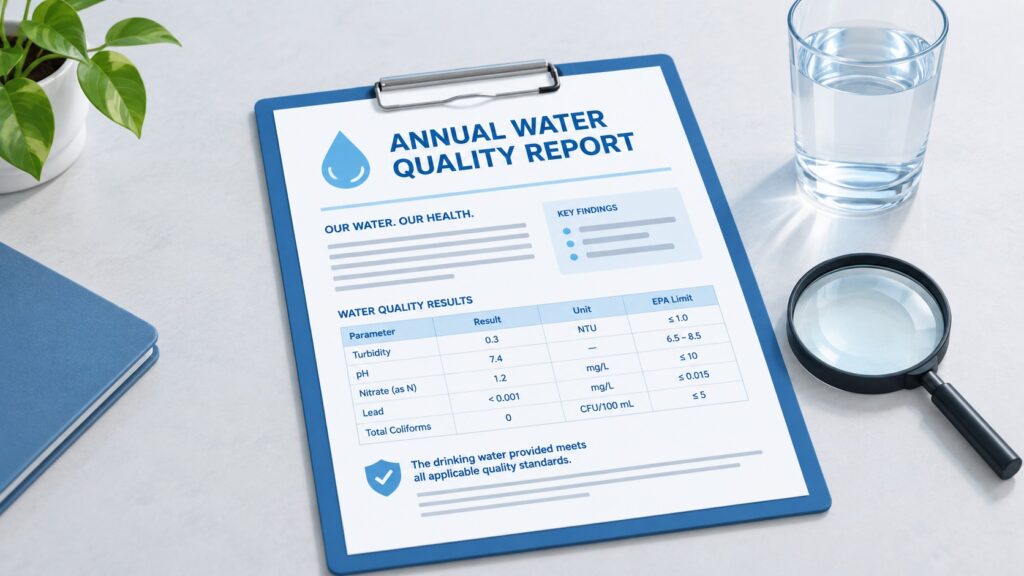
Community water systems must provide an annual Consumer Confidence Report (CCR)—often called a water quality report—by July 1. The report generally includes information about the system’s water source, regulated-contaminant monitoring, compliance status, required notices, and utility contact information (EPA, 2025).
To find yours, search the utility’s website, contact its customer-service office, or use EPA’s Consumer Confidence Report resources. A CCR gives a household a concrete starting point: the name of the water system, the relevant reporting year, and data tied to that system.
Still, a CCR is not a complete inventory of every chemical that could ever be analyzed. It focuses on required reporting and compliance information. An absent chemical does not automatically mean it has never been tested for or cannot occur. It may mean it was not a required reportable contaminant for that system or reporting period.
At Insanitek, reviewing the Consumer Confidence Report is often the first step before an on-site visit for a municipal-water concern. It helps narrow the question, identify what the utility has already monitored, and determine whether household-level testing would add useful information rather than simply duplicate records already available.
Check Public Lithium Monitoring Data Carefully
EPA’s UCMR 5 Data Finder allows users to explore available monitoring results by water system, state, contaminant, source type, and related fields (EPA, 2026a).
A careful interpretation includes the program’s limits:
- Not every U.S. public water system was required to participate in UCMR 5.
- A missing result does not automatically mean lithium is absent.
- A result below the minimum reporting level does not mean a chemical is being “secretly hidden.”
- A detection is not automatically a health-risk conclusion.
- A result alone does not show whether lithium came from groundwater geology, source-water mixing, or another identifiable pathway.
If a result raises a specific concern, the next question is not “What scary thing does this prove?” It is “What does this result mean for this water system, at this concentration, under this monitoring program?”
Ask a Specific Utility Question
If a post claims a utility is intentionally using a substance, give the utility enough information to answer a testable question. Include:
- The exact chemical name claimed.
- The original post, screenshot, or source trail if one is available.
- The name of the water system or city being discussed.
- A direct request for a written answer about testing, detection, or intentional treatment use.
For example:
“I saw a claim that [chemical] is intentionally used in treatment. Does this system test for, detect, purchase, store, or use that substance? If so, can you provide the related public record, result, or treatment document?”
A written response is useful because it can be checked against utility reports and public records. A rumor passed from one person to another cannot.
Use Targeted Testing When It Fits
Private wells, household-specific concerns, and unanswered questions may justify laboratory testing. But testing works best when it begins with a defined question. “I want to test for lithium because my well is in a region with lithium-bearing groundwater” is a defined analytical question. “I saw a post and want to test everything” is understandable, but can become expensive and difficult to interpret.
If you are in Indiana and need help selecting appropriate testing for a private well or a specific water concern, Insanitek can help you begin with a question that can actually be tested.
A 60-Second Checklist for Viral Science Claims
Before sharing a scary tap-water health claim, pause and check:
- Who is making the claim? Is the original source named and qualified?
- Where is the original evidence? Can you find an agency document, public dataset, peer-reviewed study, utility report, or laboratory record?
- What exactly is being claimed? Are the substance, location, exposure route, and timeline defined?
- How much? Does the claim state a concentration, dose, or meaningful comparison?
- Can someone else verify it? Are named water systems, laboratories, public agencies, or original documents available?
- Does it confuse “detected” with “dangerous”?
- Does it lead with urgency and technical language before providing evidence?
This is not a demand for blind trust. It is a demand for claims that are detailed enough to investigate. A public-water concern should be able to survive contact with records, measurements, and independent scrutiny.
Curiosity Is Good; Evidence Is Better
Lithium can occur naturally in some groundwater and drinking-water sources. EPA monitoring and public data are real. Research articles exploring possible effects or policy proposals are also real. None of those facts support the claim that a secret program is adding a behavioral suppressant to municipal water.
Readers do not have to choose between blind trust and panic. Start with the utility record. Check the Consumer Confidence Report. Search public monitoring data carefully. Ask for named documents. Use targeted testing when a specific, answerable question remains.
Good science does not ask people to stop asking questions. It gives them a way to ask questions that can be answered.
References
Huth, R., et al. (2022). Lithium in drinking water as a public policy for suicide prevention: An ethical discussion. International Journal of Environmental Research and Public Health, 19(4), Article 2161. https://pmc.ncbi.nlm.nih.gov/articles/PMC8891154/epa
Khalid, S., Shahid, M., Murtaza, B., Bibi, I., Iqbal, J., Niazi, N. K., & Dumat, C. (2023). Global navigation of lithium in water bodies: A review of its occurrence, health implications, and sustainable management. npj Clean Water, 6, Article 33. https://doi.org/10.1038/s41545-023-00238-wnature
Lindsey, B. D., Belitz, K., Cravotta, C. A., III, Toccalino, P. L., & Dubrovsky, N. M. (2021). Lithium in groundwater used for drinking-water supply in the United States. Science of the Total Environment, 767, 144691. https://doi.org/10.1016/j.scitotenv.2020.144691pubs.usgs
U.S. Environmental Protection Agency. (2026, August). Fifth unregulated contaminant monitoring rule data finder. https://www.epa.gov/dwucmr/fifth-unregulated-contaminant-monitoring-rule-data-finder
U.S. Environmental Protection Agency. (2026b). Fifth unregulated contaminant monitoring rule. https://www.epa.gov/dwucmr/fifth-unregulated-contaminant-monitoring-ruleepa
Lindsey, B. D., Belitz, K., Cravotta, C. A., Toccalino, P. L., & Dubrovsky, N. M. (2021). Lithium in groundwater used for drinking-water supply in the United States. U.S. Geological Survey. https://www.usgs.gov/publications/lithium-groundwater-used-drinking-water-supply-united-statesusgs
U.S. Environmental Protection Agency. (2025, November 20). CCR information for consumers. https://www.epa.gov/ccr/ccr-information-consumers