Gas pressure is often introduced through familiar objects—a balloon, a tire, a carbonated beverage, or a sealed container—but its behavior is governed by a consistent physical principle: gas particles in continuous motion transfer momentum when they collide with a boundary. When a gas is trapped, those particles cannot disperse freely into the surrounding environment. Changes in temperature, volume, or the amount of gas therefore change the pattern of molecular collisions and, consequently, the pressure exerted on the container. This article examines the historical development of gas-pressure science, the molecular basis of pressure, the relationships described by the gas laws, and the importance of container design in real systems. Particular attention is given to the difference between rigid, flexible, and vented containers, as well as the role of gas pressure in everyday scientific and technological applications.
The Importance of Confinement
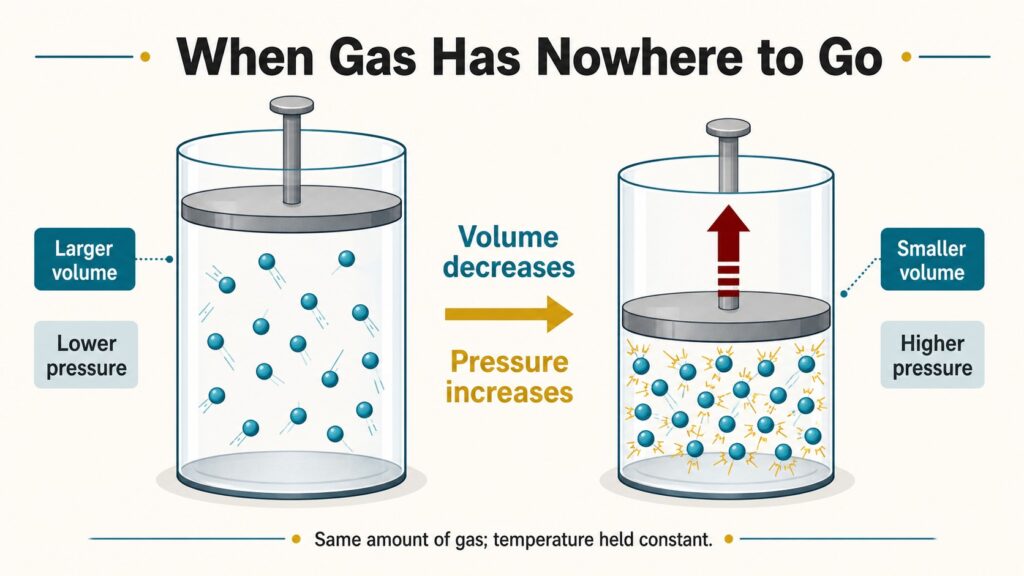
A sealed container can appear inactive while containing a highly dynamic system. Inside a capped bottle, aerosol can, tire, or pressure vessel, gas particles are not resting in place. They are moving continuously, colliding with one another, and striking the walls of the container. The resulting pressure may be stable, but it is never static in a molecular sense.
The question of what happens when gas is trapped is therefore not simply a question of whether the gas “pushes outward.” It is a question of boundaries. A gas confined within a container has a limited volume available to it, and the particles within that volume continue to move in all directions. If the gas is heated, compressed, added to, or prevented from escaping, its pressure may change substantially.
Gas pressure is important in laboratory science, industrial systems, environmental processes, physiology, food and beverage production, transportation, and household products. It explains why a bicycle pump becomes difficult to push, why a sealed carbonated bottle releases bubbles when opened, why a tire’s pressure changes with temperature, and why heating a closed container is a serious laboratory safety concern. Although these examples are familiar, the underlying science depends on molecular motion, thermodynamic variables, and the physical properties of the boundary containing the gas.
The “Spring” of Air
The study of gas pressure developed gradually as natural philosophers and chemists began to treat air as a material substance with measurable physical properties. Before modern molecular theory, air was often discussed as an apparently empty medium rather than as a collection of moving particles capable of exerting force.
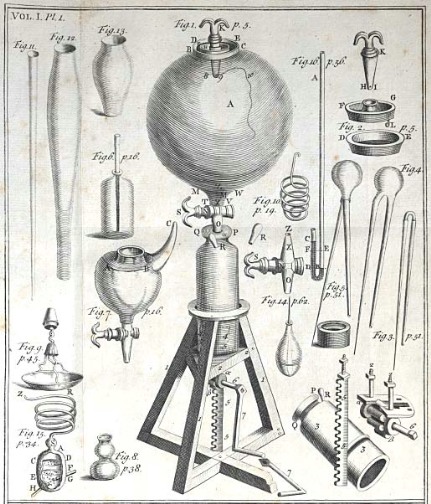
Robert Boyle’s work was central to changing that perspective. In New Experiments Physico-Mechanicall, Touching the Spring of the Air, and Its Effects, Boyle documented experiments using an early pneumatic engine, or air pump, to investigate the behavior of air under changing conditions (Boyle, 1660). Boyle used the phrase “spring of the air” to describe what modern scientists would call the elasticity or compressibility of a gas. His experiments demonstrated that air had weight, occupied space, and could produce measurable mechanical effects. Boyle’s work helped establish the experimental foundation for the inverse relationship between pressure and volume now associated with Boyle’s law.
A century later, Joseph Priestley extended the experimental study of gases through extensive investigations of what he called different “airs.” In eighteenth-century chemistry, “fixed air” referred largely to carbon dioxide. Priestley’s 1772 publication, Directions for Impregnating Water with Fixed Air, described methods for introducing fixed air into water to produce an artificial mineral-water-like beverage (Priestley, 1772). His apparatus and procedure required careful control of gas generation, transfer, confinement, and contact with water.
Priestley’s work provides a historically useful bridge between early gas chemistry and a familiar modern example of gas pressure: carbonation. In a sealed carbonated beverage, carbon dioxide exists both in the headspace above the liquid and dissolved in the liquid itself. Opening the container lowers the pressure above the liquid, allowing carbon dioxide to escape from solution as visible bubbles. Priestley’s experiments did not use the modern terminology of equilibrium, partial pressure, or Henry’s law, but they demonstrated that gases could be generated, transferred, confined, and incorporated into liquids in controlled experimental settings (Priestley, 1772).
What Is Gas Pressure?
Gas pressure is the force exerted by a gas per unit area. In the International System of Units, pressure is measured in pascals, where one pascal is equal to one newton of force applied over one square meter. Because a pascal is small relative to many everyday pressures, chemistry and physics commonly use kilopascals, atmospheres, bars, millimeters of mercury, or torr.
At the molecular level, gas pressure arises from collisions between gas particles and the walls of their container. The kinetic molecular theory of gases provides a useful model for explaining this behavior. The theory assumes that gas particles are in constant motion, that they are widely separated compared with their own size, and that collisions between particles and container walls are elastic under idealized conditions. The pressure of a gas results from the accumulation of many particle–wall collisions across a surface area (OpenStax, 2019a).
A gas does not need to be “compressed” before it creates pressure. Even air at ordinary atmospheric conditions produces pressure because its particles collide with every surface around them. The atmosphere presses on buildings, bodies of water, laboratory equipment, and the human body. Internal gas pressure becomes especially noticeable when it differs from the pressure outside a container, as in an inflated tire, pressurized canister, vacuum-sealed package, or balloon.
The question, “Why do gases create pressure?” can therefore be answered in molecular terms. Individual gas particles carry momentum because they are moving. When a particle strikes a container wall and changes direction, it transfers momentum to that wall. The wall experiences a force. Across billions upon billions of collisions, the force becomes measurable as pressure.
What Happens When Gas Is Trapped?
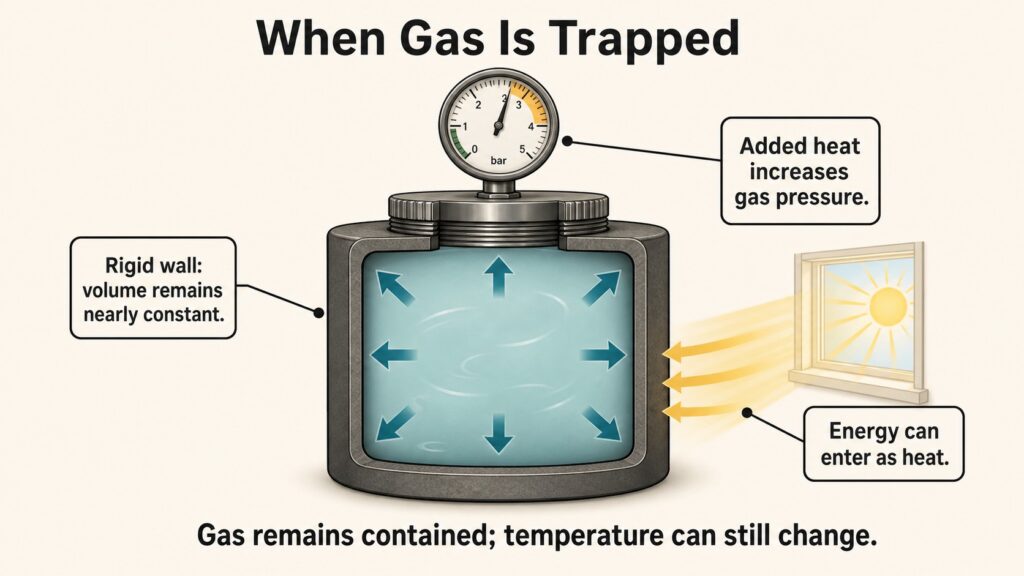
When gas is trapped in a closed container, matter cannot readily cross the container boundary. The gas particles remain within the system unless the container leaks, a valve opens, a chemical reaction consumes or produces gas, or a phase change alters the amount of material in the gas phase. Energy, however, may still cross the boundary as heat. A sealed container left in sunlight, for example, may gain thermal energy even though no gas enters or leaves.
In a rigid sealed container, the volume remains approximately constant. If the gas is heated, the average kinetic energy of the particles increases. Faster particles collide with the container walls more frequently and transfer more momentum during collision. The result is an increase in gas pressure.
This relationship can be expressed through the ideal gas law.
Ideal Gas Law: PV=nRT
In this equation, P is pressure, V is volume, n is the amount of gas in moles, R is the universal gas constant, and T is absolute temperature in kelvin. The ideal gas law combines several relationships that had previously been described separately: pressure changes with volume, with temperature, and with the amount of gas present (OpenStax, 2019b).
The equation is an approximation rather than a complete description of every real gas under every condition. Ideal-gas behavior is most reliable when gas particles are relatively far apart, such as at lower pressures and higher temperatures. Under high-pressure or low-temperature conditions, the finite volume of gas particles and attractive intermolecular forces can cause real gases to deviate from the ideal model (OpenStax, 2019a).
Still, for many classroom demonstrations and ordinary engineering examples, the ideal gas law provides an effective framework. It explains why does gas pressure increase in a closed container: pressure rises when the amount of gas increases, when the temperature increases at constant volume, or when the volume decreases while the other relevant variables remain constant.
What Affects Gas Pressure?
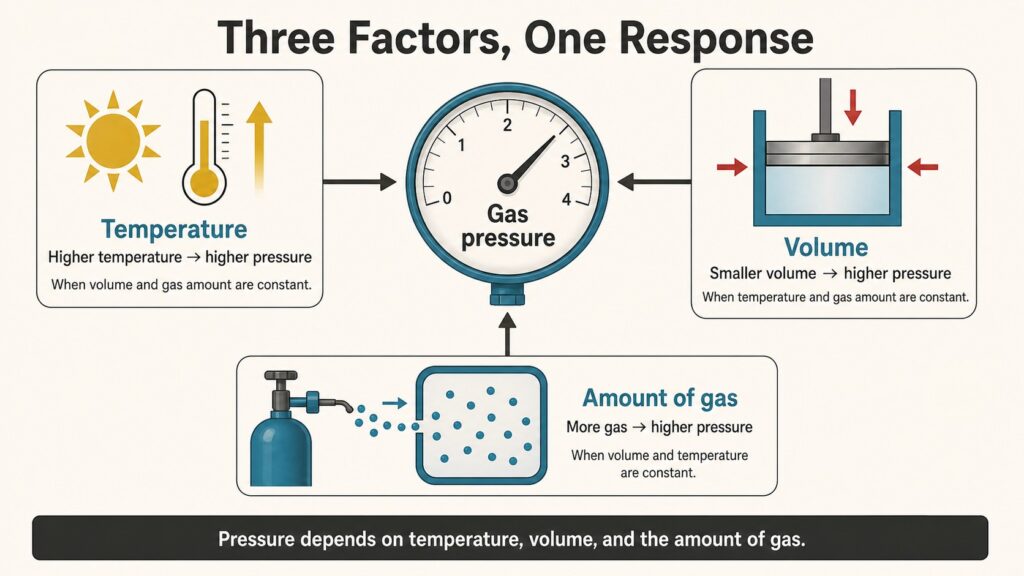
The major variables that affect gas pressure are temperature, volume, and the amount of gas present. The ideal gas law is particularly useful because it shows that these factors are related rather than independent.
Volume and Boyle’s Law
If a fixed quantity of gas is held at constant temperature, pressure and volume have an inverse relationship. As volume decreases, pressure increases. This relationship is commonly called Boyle’s law.
Boyle’s law: P1V1 = P2V2
The meaning of Boyle’s law is physical rather than merely mathematical. Imagine trapping air inside a syringe by covering the tip, then pushing the plunger inward. The amount of gas remains essentially constant, but the available volume decreases. Gas particles have less distance to travel before reaching the syringe walls or plunger. The collision rate with those boundaries increases, so the gas pressure rises.
This mechanism explains why a bicycle pump becomes more difficult to push as air is compressed into a tire. It also explains why compressed-gas cylinders contain large amounts of gas in comparatively small volumes. The pressure is not caused by the container “squeezing” the gas in a human-like sense; it is the result of confining a large number of moving particles within a limited space.
Temperature and Pressure
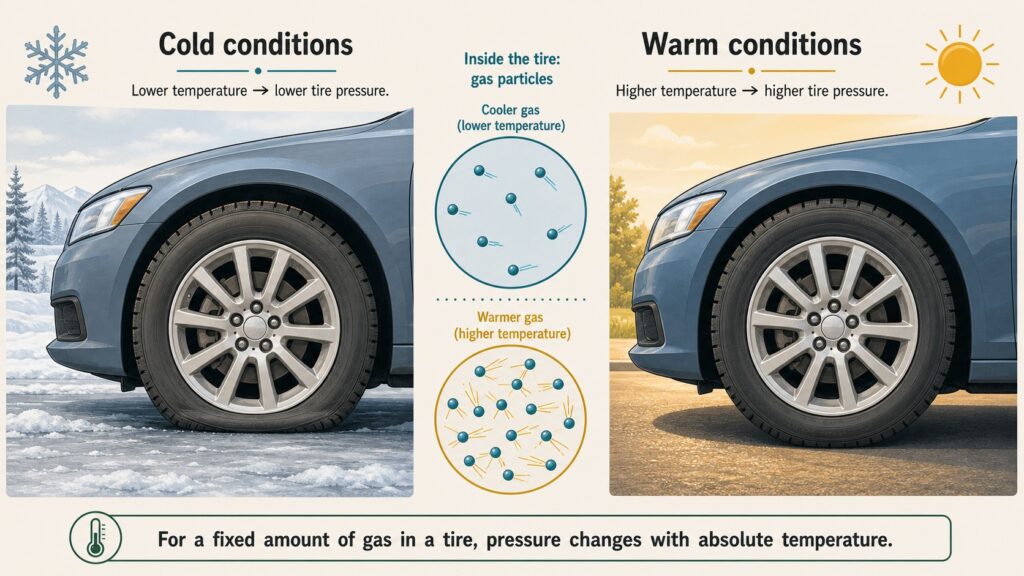
At constant volume and constant amount of gas, pressure is directly proportional to absolute temperature. This is frequently called Amontons’s law and is also often presented in introductory chemistry as the pressure–temperature form of Gay-Lussac’s law.
P1T1
=
P2T2
Temperature must be expressed in kelvin when using this relationship. Celsius and Fahrenheit scales are useful for daily life, but they do not begin at absolute zero. A ratio involving temperature in gas-law calculations must use an absolute scale.
When temperature rises in a rigid container, the average kinetic energy of gas particles increases. The particles move faster, strike the container walls more often, and produce larger momentum changes during their collisions. Pressure therefore rises. The same principle helps explain why tire pressure may increase after driving, why pressure vessels require temperature limits, and why aerosol cans carry warnings against heating or incineration.
This relationship also provides a direct safety lesson. Heating a sealed container is not a harmless way to “speed up” an experiment. If the container cannot expand and gas cannot escape, pressure can rise until a cap, seal, glass wall, or other component fails. Equipment designed for pressure service includes materials, seals, gauges, and relief systems appropriate to the intended conditions. Ordinary jars, bottles, and improvised containers do not automatically have those protections.
Amount of Gas
Does more gas increase pressure? Under constant temperature and volume, yes. Adding more gas particles to a fixed-volume container increases the number of collisions with the container walls. More collisions per unit time produce greater pressure.
P∝n, when V and T are constant.
A tire illustrates this relationship clearly. When a pump adds air to a tire, it adds more gas particles to the enclosed volume. The tire expands somewhat, but its reinforced structure limits that expansion. As the number of particles rises, the internal pressure rises until it reaches the desired operating range.
The same principle applies in gas-generating reactions. If a reaction produces carbon dioxide, hydrogen, oxygen, or another gas in a sealed rigid vessel, the number of moles of gas may increase as the reaction proceeds. Pressure can therefore increase even if the temperature remains constant. This is one reason chemical reactions that generate gas should not be conducted in closed, non-pressure-rated containers.
Why the Container Matters
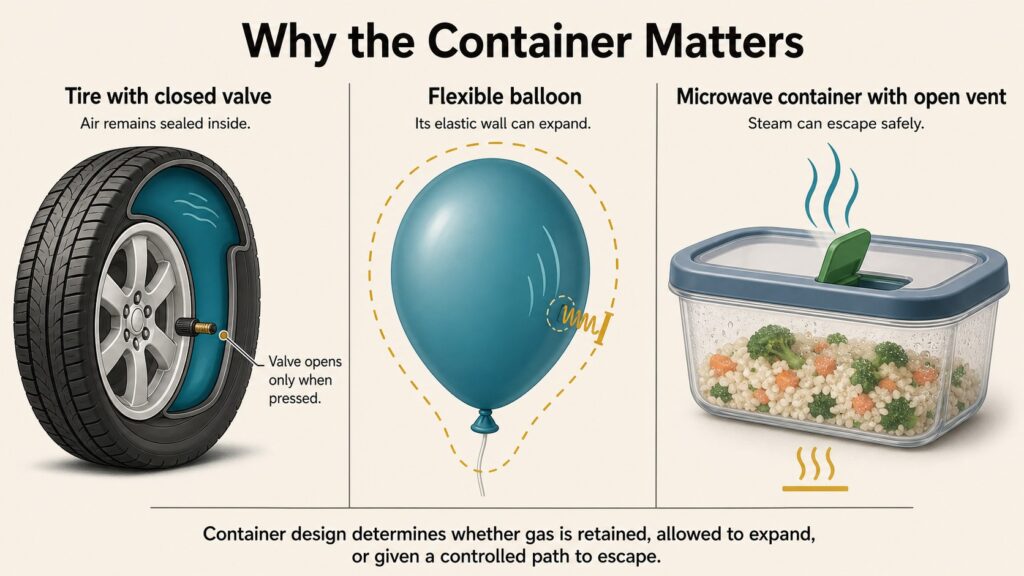
The ideal gas law describes the behavior of a gas, but real systems also depend on the mechanical behavior of the container. A gas inside a rigid steel cylinder, a plastic bottle, a syringe, a balloon, and a vented chamber does not respond in exactly the same way because the boundaries differ.
A rigid container holds its volume nearly constant. Therefore, a rise in temperature or an increase in the amount of gas primarily produces an increase in pressure. A pressure-rated gas cylinder is designed with this condition in mind. Its walls, fittings, and valves must be capable of resisting the internal forces associated with its intended maximum pressure.
Container size also matters. A larger rigid container gives a fixed amount of gas more volume, reducing the collision frequency with the walls and lowering pressure, assuming temperature remains constant. A smaller rigid container produces the opposite result. This is why how container size affects gas pressure can be understood directly through the inverse pressure–volume relationship.
A flexible container changes the situation because the boundary can move. A balloon expands as gas is added, increasing its volume and reducing the extent to which pressure rises compared with a rigid vessel. However, a balloon is not simply an ideal-gas container with freely adjustable volume. Its rubber or latex membrane resists stretching, and that elastic tension contributes to the pressure inside the balloon. The final state reflects the balance among internal gas pressure, outside atmospheric pressure, and the mechanical properties of the balloon material.
A syringe provides an intermediate example. It may be closed to gas flow, but its plunger can move. If the plunger is free to move, the gas can expand or contract as needed to approach mechanical equilibrium with the external force. If the plunger is held fixed, the syringe behaves more like a rigid container. The difference is not whether the gas is “trapped” in a casual sense, but whether the boundary allows its volume to change.
Finally, a vented container permits gas to escape. When gas leaves, the amount of gas remaining inside decreases. If temperature and volume are otherwise unchanged, the pressure decreases. This is the principle behind pressure-relief valves, which provide a controlled escape route before internal pressure exceeds the safe operating limit of a system.
Gas Pressure in Everyday Life
Gas pressure examples in everyday life are useful because they show that the same molecular principles operate across very different systems. The examples below are not separate facts to memorize; each is an application of particle motion, confinement, and boundary conditions.
A carbonated beverage is a gas–liquid system under pressure. Before opening, carbon dioxide is present in the headspace and dissolved in the liquid. The sealed cap keeps the pressure above the liquid higher than atmospheric pressure. Opening the bottle allows gas to escape from the headspace, lowering pressure. Carbon dioxide then becomes less soluble in the liquid and forms bubbles that rise and escape. Shaking the bottle creates many bubble-nucleation sites and can distribute gas through the liquid, so pressure release may lead to vigorous foaming.
Aerosol cans contain materials under pressure and should never be heated, punctured, or burned. The details vary by product because some aerosols use liquefied propellants while others use compressed gas, but the safety principle remains consistent: heating a confined pressurized system can raise internal pressure and increase the risk of container failure.
Tires also demonstrate the interaction between gas pressure and flexible boundaries. Their internal air pressure pushes outward, while the tire casing provides structural resistance. Tire pressure changes with temperature because the contained gas is warmed during driving and by environmental conditions. For that reason, pressure specifications are generally evaluated when tires are “cold,” before the heat generated by operation significantly changes the gas temperature.
Human breathing relies on controlled pressure differences rather than permanently trapped gas. When the diaphragm contracts and the chest cavity expands, lung volume increases. Internal pressure decreases slightly relative to atmospheric pressure, allowing air to flow inward. During exhalation, lung volume decreases and internal pressure rises relative to the surrounding air, driving air outward. Air moves because of the pressure gradient created by changing volume.
These real-life examples of gas pressure in science demonstrate a broader principle: gases respond predictably to constraints. Whether the constraint is a tire wall, a bottle cap, a balloon membrane, a syringe plunger, or the changing volume of the chest cavity, the behavior of the gas depends on the relationship among particle motion, temperature, quantity of gas, available space, and the ability of the system to release pressure.
Conclusion
When gas has nowhere to go, its particles do not become inactive. They continue moving, colliding, and exerting force on every surface available to them. Gas pressure is the measurable consequence of those molecular collisions. In a closed system, changes in temperature, volume, or the amount of gas alter the collision pattern and can change pressure substantially.
The ideal gas law provides a unified model for these relationships, while Boyle’s law and the pressure–temperature relationship offer focused ways to examine specific conditions. Yet the gas alone does not determine the outcome. The container matters. A rigid vessel, flexible balloon, movable syringe, and vented system each impose different boundary conditions, changing how the system responds to added gas, compression, heating, or release.
From Boyle’s investigations of the “spring of the air” to Priestley’s experiments with fixed air and carbonated water, the history of gas science shows that pressure is both observable and controllable. Modern applications—from tires and breathing to aerosol products and carbonated drinks—continue to depend on those same underlying principles.
Continue the investigation
Gas pressure becomes more useful when learners can observe it in a real system: a sealed vessel, a flexible boundary, a temperature change, or a controlled release path. Our upcoming Chemistry of Materials labs explore how physical conditions, material properties, and chemical behavior interact in practical investigations.
References
Boyle, R. (1660). New experiments physico-mechanicall, touching the spring of the air, and its effects: Made, for the most part, in a new pneumatical engine. H. Hall for T. Robinson. Internet Archive digital copy
OpenStax. (2019a). Chemistry 2e (Section 9.5, The kinetic-molecular theory). Rice University. https://openstax.org/books/chemistry-2e/pages/9-5-the-kinetic-molecular-theory
OpenStax. (2019b). Chemistry 2e (Section 9.2, Relating pressure, volume, amount, and temperature: The ideal gas law). Rice University. https://openstax.org/books/chemistry-2e/pages/9-2-relating-pressure-volume-amount-and-temperature-the-ideal-gas-law
Priestley, J. (1772). Directions for impregnating water with fixed air: In order to communicate to it the peculiar spirit and virtues of Pyrmont water, and other mineral waters of a similar nature. J. Johnson. Wellcome Collection digital copy