
Most school systems teach in blocks. Peak into any school, and you’ll see that they are teaching one topic. It usually goes introduction, explanation, practice, revise, and then finally a testing for mastery. Rinse, repeat ad nauseam. You likely know this as most people teach in this method because that’s how they were taught. It’s the concept of attempting to master one specific skill or topic in a subject before moving onto the next.
There are two ideas hiding inside this problem: spaced practice and interleaving. Spaced practice means coming back to something after time has passed. Interleaving means mixing related topics or skills instead of practicing only one type at a time. They are not identical, but they work well together when you want people to remember what they learned and recognize when to use it.
We all know how well this works. Eventually, it does. For some people it works really well. Others… not so much. So let me introduce you to the learning method called “interleaving.” You may find that it opens up a whole new world for you and those that you pass knowledge onto.
I first learned about spacing and interleaving when I was in school. My private boarding school used both as part of managing my ADHD, and I can tell you from experience that they beat trying to beat one topic into your head until your brain gives up and goes home. We returned to skills over time and mixed them with closely related skills. I still use that approach when I teach, especially in hands-on science. Honestly, that is part of why the hands-on portion exists. Students can see a scientific concept doing something instead of only hearing a definition, reading a chapter, or trying to memorize the right words for a quiz. When we return to the idea later, they have an actual experiment, observation, or “oh, that is what happened” moment to connect it to.
Interleaving Learning 101
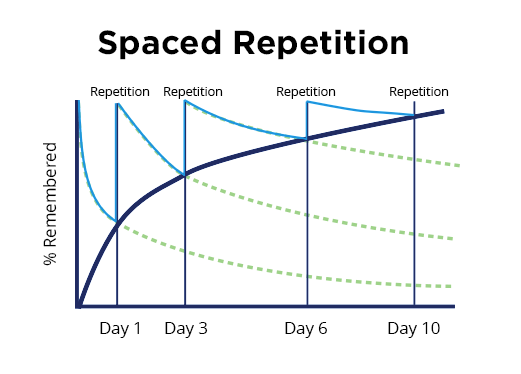 Interleaving is often used alongside spacing, so we need to talk about spacing first.
The idea behind spacing is not new. Hermann Ebbinghaus (1885) published foundational work on memory and forgetting in 1885. He did not create every modern study strategy people use today, but his work helped establish the research tradition around how people learn, forget, and remember information over time.
We all have real-life examples of this. It is called cramming.
You study for a presentation with a client or wait until the last minute to study for an exam. You can usually remember the information long enough to get through the immediate thing. A day or two later? Maybe not so much.
That is where spacing comes in. Spaced practice means returning to a topic after some time has passed instead of trying to learn or review everything back-to-back in one big block. You learn something, leave it alone for a while, and then come back to it. The first time you return, recall may be rough. You are no longer just looking at information you saw five minutes ago—you have to pull it back out of your brain.
As you can see from the graph above, recall is not always pretty at first. That does not mean the method is failing. The more you return to information and actually use it, the more natural it can become and the easier it may be to recall later. It is a slower method than cramming, but the potential for long-term recall is greater. Modern research reviews refer to this as distributed practice and rate it as a high-utility learning technique for supporting learning over time (Dunlosky et al., 2013).
I first learned about spacing and interleaving when I was in school. My private boarding school used both as part of managing my ADHD, and I can tell you from experience that they beat trying to beat one topic into your head until your brain gives up and goes home. We returned to skills over time and mixed them with closely related skills.
I still use that approach when I teach, especially in hands-on science. Honestly, that is part of why the hands-on portion exists. Students can see a scientific concept doing something instead of only hearing a definition, reading a chapter, or trying to memorize the right words for a quiz. When we return to the idea later, they have an actual experiment, observation, or “oh, that is what happened” moment to connect it to.
Interleaving is different from spacing, although the two work well together. Interleaving means mixing practice of closely related topics or skills instead of practicing one kind of task over and over again. It is not simply taking a break between study sessions, and it is not randomly hopping between unrelated subjects.
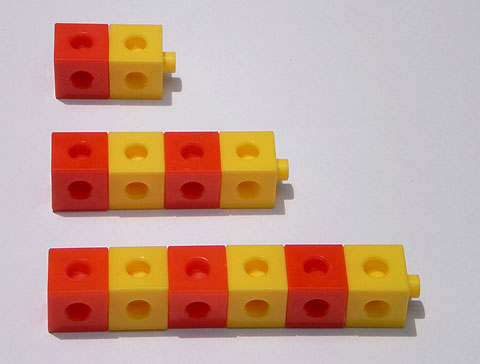
Take a look at the Legos below. The whole stick represents one topic. The orange color represents the new topic you are trying to learn, and the yellow represents concepts you already know or skills that are closely related. In the shortest stick, you alternate between two mini-skills. In the larger ones, you can alternate between the new skill and several previous skills you know.
For example, if you are trying to learn kung fu—and who does not want to be Bruce Lee?—you might shuffle between footwork, punches, kicks, and posture. Those are all closely related skills. You would not go from footwork to accounting to studying European capitals.
When you are learning a new topic, keep it simple, like the Legos to the right. Mix the new skill—the orange—with familiar and closely related skills—the yellow. That gives you a chance to see how the skills connect without making the whole thing so complicated that everyone gets overwhelmed before they have had a chance to understand the basics.
In hands-on science, this can mean coming back to density while students are investigating buoyancy, mixtures, mass, or volume. They are not just being asked to repeat a definition. They can see where the concept shows up, what it explains, and when it matters.
Combining spacing and interleaving
For better study habits, use spacing and interleaving together. One simple way to do that looks like this:
Spend about 10 minutes on one topic. Read it and make sure you understand it at a rudimentary level, then move on to a related topic.
- Study a related skill you are already familiar with for 3–5 minutes.
- Pause for about 10 minutes. Get a drink of water. Stand up. Move around a little.
- Go back to the original topic for another 10 minutes.
- Study another related skill for 3–5 minutes.
Then stop.
Seriously. Stop for a day or so, then come back and review in the same interleaving fashion.
The point is not that every person has to follow this exact schedule. The point is to give yourself some space from the new material, then come back and connect it with something related instead of reading the same page over and over until your eyes glaze over. Research on spacing does not identify one perfect interval for everyone, but it does support spreading review across time rather than doing all of it in one sitting (Dunlosky et al., 2013).
In a real scenario, this could look like introducing the topic of ratios. Ratios are related to fractions, so after reading the introduction in the book and trying to understand what it is saying, you could go back and look at fractions with that connection in mind. Then pause, get up, and move around a little. When you come back, review the information about ratios and what you just connected with fractions. Then continue moving forward.
You are not trying to turn ratios into fractions or pretend they are exactly the same thing. You are using a familiar skill to give the new one somewhere to stick. Later, when you revisit ratios again, you can mix in fractions and other related topics so you have to think about which one you are actually looking at.
References:
Ebbinghaus, Hermann. *Memory: A Contribution to Experimental Psychology*. 1885. Historical foundation for the discussion of memory and forgetting.
Dunlosky, John, Katherine A. Rawson, Elizabeth J. Marsh, Mitchell J. Nathan, and Daniel T. Willingham. “Improving Students’ Learning With Effective Learning Techniques: Promising Directions From Cognitive and Educational Psychology.” *Psychological Science in the Public Interest* 14, no. 1 (2013): 4–58. Modern review identifying distributed practice as a high-utility learning technique.